

Vastu Shastra · Home Design
Vastu for Homes in North America: Complete Guide
North American homes—whether single-family, townhouse, condo or rental—can harmonize beautifully with Vāstu when we translate directions, seasons and building practices correctly. Use this region-aware guide to map entrances, kitchens, bedrooms, home offices, basements and garages to supportive zones, without breaking building codes or HOA rules.
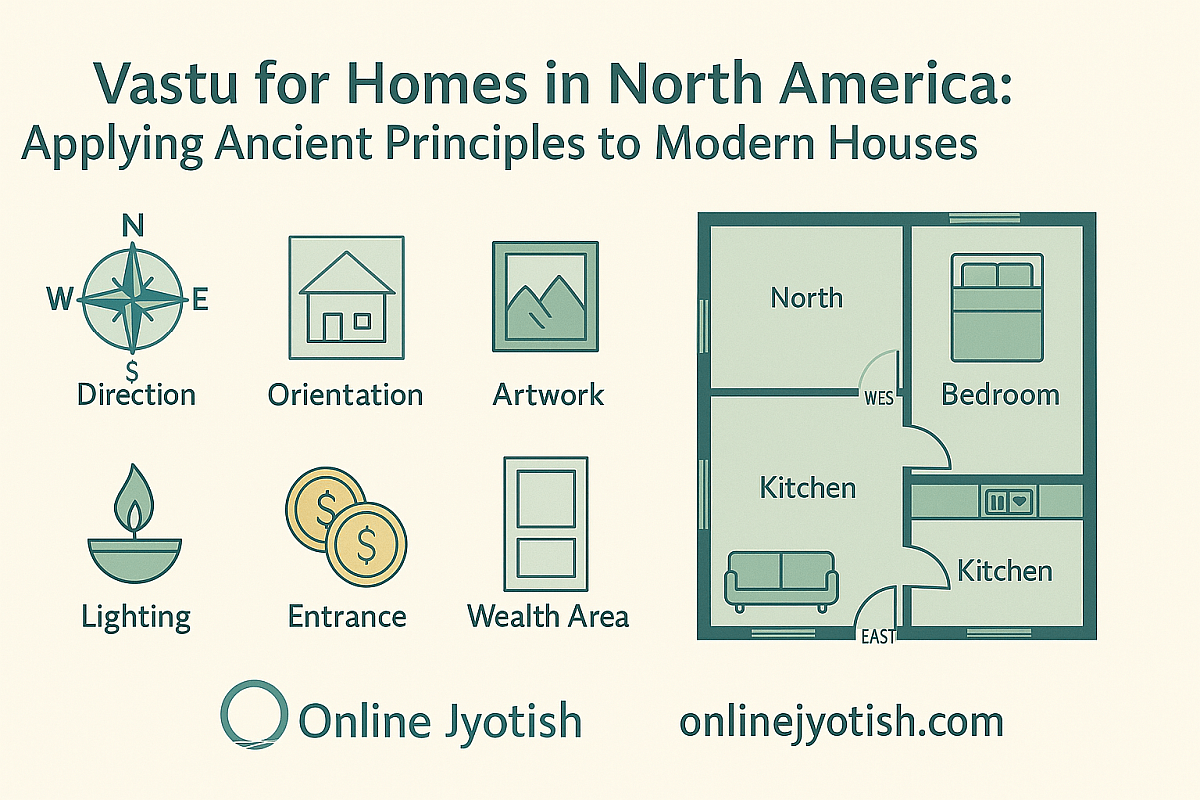
1) Orientation: True North, Not Just Magnetic
- Use true north: Calibrate your phone’s compass and enable location so it shows true north. Many NA cities have a noticeable magnetic declination; plotting from the home’s center is essential.
- Street grids: Suburban streets often run off-cardinal. Align your internal Vastu grid to true north even if the façade is skewed. This is key for diagonal lots.
- Center (Brahmasthān): Keep this central area open for clear circulation; avoid heavy storage, structural beams, or large pendant lights dominating the exact center.
Tip: Mark directions on your floor plan once and reuse for all placements.

2) Entrances & Foyers (Curb Appeal meets Vastu)
| Door Direction | General Qualities | What to Emphasize | Avoid |
|---|---|---|---|
| North | Steady inflow, practicality | Clear path, warm light, tidy shoes/coat area | Clutter piles, leaking fixtures |
| East | Growth, visibility | Daylight, clean glass, live greens | Dark, cramped foyers |
| North-East | Clarity, sanctity | Light décor, prayer niche nearby | Heavy furniture, shoe racks |
| West | Stability, consolidation | Neutral palette, statement art | Sharp, jutting décor |
| South/North-West | Discipline/movement | Strong organization, warm lighting | Loud, chaotic entry |
| South-West | Too heavy for entry | Visual lightness if unavoidable | Clutter, mirrors facing door directly |
Foyer rules: Door opens fully without hitting furniture; doormat is clean and in good condition; no broken hardware; soft, warm lighting; pleasant scent.
3) Room-by-Room Placements (US/Canada layouts)
Living / Family Room
- Prefer North/East for daily use spaces; arrange seating so most people face East/North.
- Keep North-East corner light—ideal for a low altar or reading nook, not the heavy media center.
Kitchen & Dining (overview—details in Section 4)
- South-East (Agni) is classic for the stovetop; North-West works as a secondary option. (Read more about Kitchen Vastu here).
- Dining near East/North lets morning light set the tone; avoid placing dining in a dark South-West corner.
Primary Bedroom
- Prefer South-West for stability and rest. Bed headboard on South/West wall; sleeper’s head towards East/South.
- Avoid mirrors facing the bed; if built-in closets have mirrors, keep them behind doors or cover them at night.
Children’s / Guest Bedrooms
- West/North are good; study desks should face East/North for concentration. Keep the North-East corner of the room clear for play/reading.
Home Office / Study
- Choose North (for finance/data) or East (for communication/marketing). Desk should face East/North, with a solid wall behind your chair for support.
- Avoid placing the main desk in the South-West corner if it becomes heavy and closed-in—use SW for cabinets and storage instead.
Puja / Prayer Niche
- North-East is ideal; otherwise East. Keep it elevated, clean, and free from adjacent bathroom or laundry walls if possible. (See our guide on Vastu for Puja Rooms).
Bathrooms
- Prefer North-West or South-East. Keep exhaust fans working, sealants fresh, and leaks fixed quickly. The toilet lid should always be kept down.
Staircases
- A clockwise rise is preferred from the entry level; place them toward the South/West quadrants where feasible. Keep under-stair storage neat.
4) Modern Utilities: Kitchen, HVAC, Laundry, Fireplaces
Kitchen (North American appliances)
- Stove/Oven: South-East (ideal) or North-West; cook facing East.
- Sink/Dishwasher: North-East/North. Separate fire (stove) and water (sink) with counter space.
- Fridge/Pantry: South/West walls work; avoid blocking North-East corners.
Safety First: Follow all local fire, ventilation, and electrical codes. Never bypass carbon-monoxide and smoke detectors for Vastu reasons.
HVAC / Furnace / Water Heater
- Heating elements (furnace, boiler, tank water heater) align with the fire element, favoring South-East or South; ensure proper service clearances.
- Air conditioning condensing units outside should not clutter the North-East; screen them with plants if needed (while allowing airflow).
Laundry (Washer/Dryer)
- North-West or South-East are suitable. Maintain dry floors; fix vibrations; keep detergents closed and off North-East floors.
Fireplaces
- Preferably on a South or South-East wall of the living room. Balance its fire energy with water/greenery toward the North/East of the room.
5) Basements, Garages & Attics
- Basements: Keep them bright and dry. Use for storage, a gym, media room, or hobby areas. Avoid placing primary bedrooms in the deep South-West of a basement; if unavoidable, add a solid headboard on the West/South wall and extra lighting in the North-East.
- Garages: West/North-West are fine placements. Maintain cleanliness; avoid storing broken equipment, especially in the North-East corner of the garage.
- Attics: Keep them clutter-free. Heavy, long-term storage directly over a bedroom’s North-East area is discouraged.
6) Condos, Townhomes & Rentals (Non-structural fixes)
- Use area rugs with earthy tones to “weight” the South/West; keep North-East visually light with blues and whites.
- Place mirrors on North/East walls to expand the sense of space; avoid mirrors that directly face the main door or reflect the bed.
- Arrange your desk so you face East/North with a solid wall behind you.
- For kitchens not in SE/NW, rely on color zoning (warm tones for the stove zone) and a clean separation between the stove (fire) and sink (water).
- Place beneficial plants (money plant, bamboo, peace lily) in East/North; avoid cacti/thorny species indoors.
- Use movable screens to define a prayer nook in the North-East; keep it elevated, clean, and respectful.
7) Climate & Daylight (North American latitudes)
- Daylight strategy: In the Northern Hemisphere, South-facing windows admit strong light—great for living areas in cold regions; use shades or overhangs in hot summers. East-facing windows bring in beneficial morning light.
- Snow & rain: Keep North-East gutters and downspouts clean to prevent water stagnation. Ensure good drainage away from the foundation.
- Ventilation: Winter dryness and summer humidity require balanced humidification/dehumidification—clean HVAC filters regularly to improve indoor air quality (“prāṇa”).
8) Colors, Materials, Plants & Mirrors
- North-East: Whites, light blues, pastels. Keep airy and uncluttered.
- East/North: Fresh whites, light greens. Good for family photos, certificates.
- South-East: Warm whites, silver, earthy ochres. Avoid excessive red.
- South/South-West: Earth tones (beige, light brown). Supports heavy furniture and storage.
- West: Blues, whites, grays. Good for bookshelves, study aids.
- North-West: Light grays, whites. Supports a guest room or laundry area.
- Mirrors: On North/East walls to expand energy; not facing bed/door directly.
- Aquarium: In the North/East (only if maintained diligently; stagnant water is negative).
9) Quick Zone Map
| Zone / Direction | Best Use | Avoid | Notes |
|---|---|---|---|
| North-East (Īśānya) | Puja, meditation, light seating | Toilets, heavy storage, kitchen | Keep bright and uncluttered |
| East | Study/home office, morning dining | Dark blinds, clutter | Maximize daylight |
| South-East (Agni) | Stove/oven, fireplace, utilities | Mixing sink & stove, bedroom | Fire-water separation is key |
| South | Closets, stairs, storage | Prayer nook, main entrance | Use stable, earthy palette |
| South-West | Primary bedroom, storage | Main entry, bathrooms, kitchen | Headboard on South/West wall |
| West | Dining, study, garage | Stagnant storage piles | Good for bookshelves |
| North-West | Guest room, laundry, movement | Safe/locker, deep storage | Keep air circulating |
| North | Home office (finance), living area | Toilets, heavy furniture | Keep pathways clear |
| Center (Brahmasthān) | Circulation, light activity | Heavy fixtures, walls, clutter | Open and balanced |
10) Outdoor Spaces: Decks, Gardens & Landscaping
- Decks & Patios: Ideally located in the East or North of the house to take advantage of gentle morning and ambient light. Avoid overly heavy constructions that block light to the main house.
- Landscaping Slope: The land should ideally slope down from South/West towards North/East, allowing positive energy and water to flow correctly. If your yard slopes the other way, you can use terracing or raised garden beds in the SW to create a similar effect.
- Trees & Heavy Plants: Plant large, heavy trees in the South and West to provide shade and act as a stabilizing barrier. Avoid planting them too close to the house foundation.
- Lighter Plants & Lawns: Keep the North and East areas more open, with lawns, flower beds, and smaller shrubs. A Tulsi (holy basil) plant is excellent for the North-East.
- Water Features: A small fountain or birdbath is best placed in the North-East, but ensure the water is constantly moving and clean.
Printable Checklist
- ✔ Calibrate compass to true north from home’s center.
- ✔ Keep North-East light, clean and uncluttered, both inside and out.
- ✔ Stove in SE/NW; sink in N/NE; maintain fire-water separation.
- ✔ Primary bedroom in SW; solid headboard; mirrors not facing bed.
- ✔ Desk faces East/North; solid wall behind; cables organized.
- ✔ Bathrooms only in NW/SE; exhaust fans working; no leaks.
- ✔ Garage West/NW; basement bright, dry; avoid heavy SW bedrooms there.
- ✔ Yard slopes toward NE; heavy trees in SW; lighter plants in NE.
- ✔ Entry is well-lit, clutter-free; no broken hardware.
- ✔ All changes respect local building, fire, and HOA codes.
Compliance Note: Vastu should complement—never conflict with—local safety regulations, building codes, or architectural advice.
FAQs
Can Vastu be applied in condos/apartments with fixed layouts?
Yes—focus on orientation of bed/desk, mirrors on North/East walls, plants in East/North, and a clean North-East. Use movable screens for prayer nooks and color zoning for kitchens.
How do I handle basements and garages?
Use basements for storage/gym/media; keep them bright and dry. Garages are fine in West/North-West. Avoid heavy South-West bedrooms in basements when possible.
Which direction should my main door face?
North/East are generally growth-oriented; West is stable. South can work with balanced colors and strong organization. More important: an unobstructed entry and a clean North-East. If you want to check which direction is personally suitable,
check this link.
How do I select a house in the US when rows are diagonal and the main entrance isn't in a correct direction?
When a home's entrance isn't ideal due to a diagonal street layout, prioritize the internal Vastu compliance. Focus on getting the "big five" correct:
1) Kitchen in the Southeast,
2) Master Bedroom in the Southwest,
3) Prayer Area in the Northeast,
4) Living Areas in the North/East, and
5) Bathrooms in the Northwest. The more of these core placements you can align, the more you mitigate the effect of a sub-optimal entrance.


 Want to find a good partner? Not sure who is the right match? Try Vedic Astrology! Our Star Matching service helps you find the perfect partner. You don't need your birth details, just your Rashi and Nakshatra. Try our free Star Match service before you make this big decision!
We have this service in many languages:
Want to find a good partner? Not sure who is the right match? Try Vedic Astrology! Our Star Matching service helps you find the perfect partner. You don't need your birth details, just your Rashi and Nakshatra. Try our free Star Match service before you make this big decision!
We have this service in many languages:
 If you're searching for your ideal life partner and struggling to decide who is truly compatible for a happy and harmonious life, let Vedic Astrology guide you. Before making one of life's biggest decisions, explore our free marriage matching service available at onlinejyotish.com to help you find the perfect match. We have developed free online marriage matching software in