

How to Plan Your Perfect Day: A Beginner’s Guide to Using a Daily Panchang
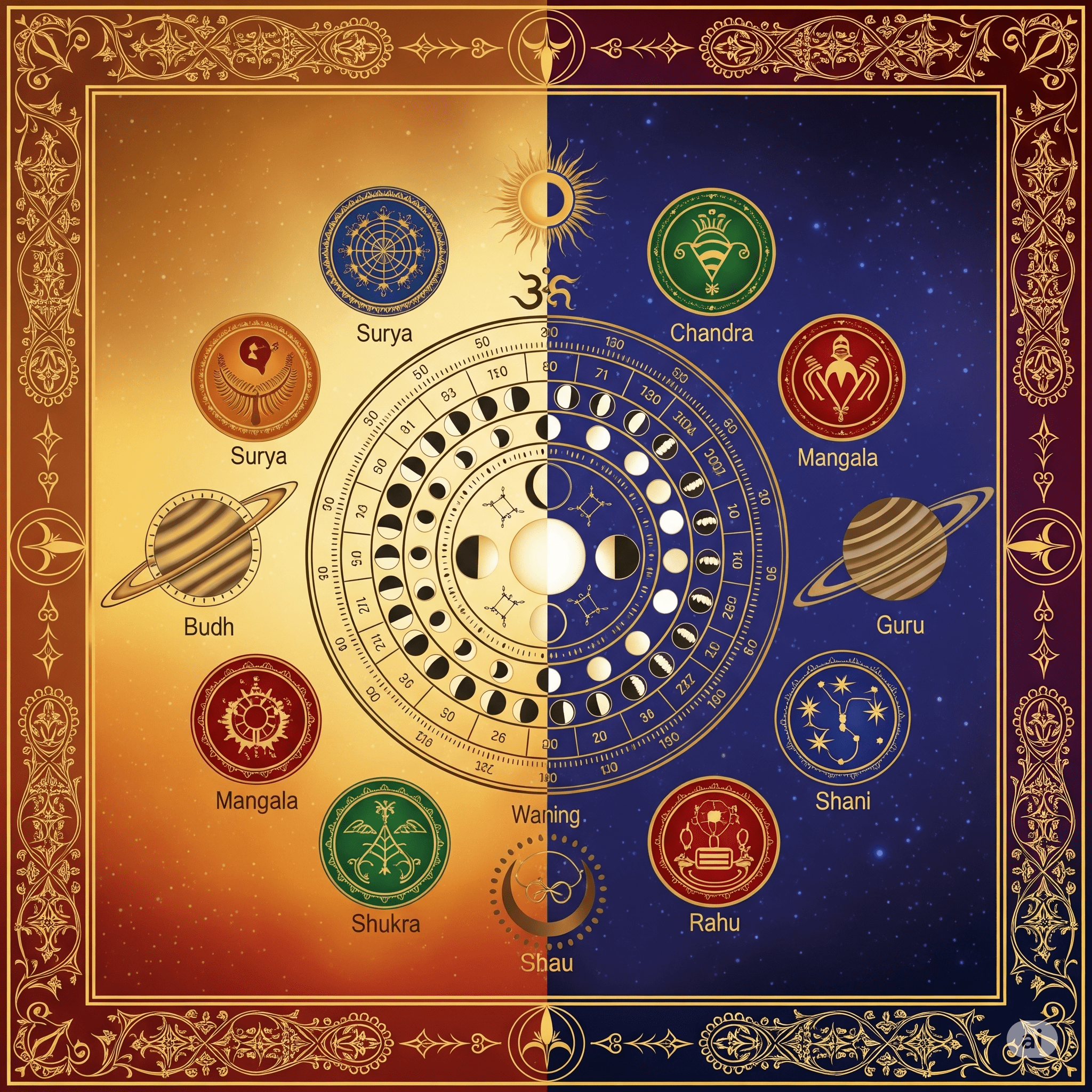 Ever have one of those days where everything just feels “off”?
According to Vedic wisdom, timing is everything. The
Panchang—a five-limbed daily almanac—helps you pick the right moments to start, pause, or avoid activities so your day flows better. In this guide, you’ll learn the basics and how to use a free online
Panchang,
Hora, and
Choghadiya tool to plan a productive day.
Ever have one of those days where everything just feels “off”?
According to Vedic wisdom, timing is everything. The
Panchang—a five-limbed daily almanac—helps you pick the right moments to start, pause, or avoid activities so your day flows better. In this guide, you’ll learn the basics and how to use a free online
Panchang,
Hora, and
Choghadiya tool to plan a productive day.
What is a Panchang?
Panchang (pañcāṅga = “five limbs”) summarizes five daily factors that color the quality of time:
- Tithi (Lunar Day): Emotional tone; good for choosing starts or completions.
- Vāra (Weekday): Day-lord’s flavor (Sun=leadership, Moon=care, Mars=action, Mercury=trade/communications, Jupiter=wisdom/meetings, Venus=arts/comfort, Saturn=discipline).
- Nakshatra (Lunar Mansion): The “mood” of the sky—supports certain themes (learning, travel, repairs, etc.).
- Yoga: Overall harmony or stress in the day’s energy.
- Karana: Half-tithi slices—useful for fine-tuning start times.
You don’t have to memorize everything. For everyday use, focus on the key do/don’t windows below.
The Timings You MUST Know
1) Rahu Kaal (Rāhu Kāla) — avoid fresh starts
This is a daily inauspicious window. Avoid beginning new projects, first meetings, launches, or journeys here (routine work is fine). Look up Rahu Kaal for your exact city in the Panchang tool.
2) Gulika & Yamaganda — caution
- Gulika Kaal: Not ideal for initiations; fine for routine, review, or maintenance.
- Yamaganda: Especially avoided for travel and first-time attempts.
3) Choghadiya — quick “good vs avoid” slots
Day/night are split into short blocks labeled Amrit, Shubh, Labh, Char (good) and Rog, Kaal, Udveg (avoid). Use Amrit/Shubh/Labh for calls, outreach, or departures. Check the Choghadiya table for your city/date.
4) Hora — planet-ruled hours
Every hour (approx.) is ruled by a planet. Pick the Hora that matches your task:
- Sun: Leadership, visibility, authority tasks
- Moon: Care, branding, public-facing work
- Mars: Quick action, repairs, decisive moves
- Mercury: Emails, sales calls, contracts, short travel
- Jupiter: Pitches, interviews, strategy, negotiations
- Venus: Design, partnerships, client harmony
- Saturn: Planning, compliance, long-term tasks
How to Use the Free Tool (2 minutes)
- Open the Daily Panchang: Set your city & date. You’ll see the five limbs plus a dashboard of Rahu Kaal, Yamaganda, Durmuhurtam, and Hora snippets.
- Note the “avoid” windows: Rahu, Yamaganda, Gulika (and Durmuhurtam if present).
- Open Choghadiya: Mark Amrit/Shubh/Labh slots for your city/date.
- Open Hora: Identify Mercury/Jupiter Horas (great for meetings) or the Hora that suits your task. Change date & location as needed.
- Pick your start time where it’s not Rahu/Yamaganda/Gulika, is a good Choghadiya (Amrit/Shubh/Labh), and aligns with a supportive Hora (e.g., Mercury/Jupiter for business).
Tip: Always plan by your city’s sunrise/sunset, since these windows shift by location. The tool handles this automatically.
A Practical Example: Planning a Day in August 2025
Scenario: You want to schedule an important business meeting next week (e.g., Tuesday, August 26, 2025) for your city.
- Daily Panchang: Select Aug 26, 2025 and your city. Note the day-lord (Vāra) and the Rahu, Yamaganda, Gulika timings—block those out.
- Choghadiya: Mark the Amrit/Shubh/Labh windows that fall outside the “avoid” periods.
- Hora: Find a Mercury or Jupiter Hora overlapping a good Choghadiya block. That overlap is your prime slot for a pitch, negotiation, or strategy meeting.
- If no perfect overlap exists, pick the best available: a good Choghadiya with at least a neutral Hora—still avoid Rahu/Yamaganda/Gulika.
Quick Do/Don’t Cheatsheet
| DO | DON’T |
|---|---|
| Start launches, first meetings, journeys in Amrit/Shubh/Labh or Mercury/Jupiter Hora. | Begin anything new in Rahu, Yamaganda, or Gulika (routine work is okay). |
| Use Saturn Hora for long-term planning/compliance; Venus Hora for client rapport/design. | Forget location—times are city-specific; always set your city in the tool. |
FAQs
What is a Panchang?
Panchang is a five-limbed Vedic almanac— Tithi, Vara, Nakshatra, Yoga, and Karana—that helps you pick auspicious times and avoid inauspicious windows.
What are Rahu Kaal, Yamaganda, and Gulika?
They are daily caution periods. Rahu Kaal is generally avoided for new starts; Yamaganda for travel and fresh attempts; Gulika for initiations.
How do I choose the best time to start something?
Avoid Rahu/Yamaganda/Gulika, then pick a good Choghadiya block ( Amrit/Shubh/Labh) that overlaps with a supportive Hora like Mercury or Jupiter.
Are these timings location-specific?
Yes. They depend on your city’s sunrise and sunset. Always set your location in the Panchang tool.
Conclusion
A little timing goes a long way. By avoiding the daily “no-go” windows and lining up your important tasks with supportive Choghadiya and Hora, you’ll notice more flow, fewer roadblocks, and better outcomes—often with the same effort.
Call to Action: To explore the Daily Panchang for your location, try the free tool and read my full review of Om Sri Sai Jyotisha Vidyapeetham.


 Are you searching for a detailed Panchang or a daily guide with good and bad timings, do's, and don'ts? Our daily Panchang service is just what you need! Get extensive details such as Rahu Kaal, Gulika Kaal, Yamaganda Kaal, Choghadiya times, day divisions, Hora times, Lagna times, and Shubha, Ashubha, and Pushkaramsha times. You will also find information on Tarabalam, Chandrabalam, Ghata day, daily Puja/Havan details, journey guides, and much more.
 If you're searching for your ideal life partner and struggling to decide who is truly compatible for a happy and harmonious life, let Vedic Astrology guide you. Before making one of life's biggest decisions, explore our free marriage matching service available at onlinejyotish.com to help you find the perfect match. We have developed free online marriage matching software in