

Navaratri Day 3 — Chandraghanta Devi: Alankara, Significance & Puja Vidhi
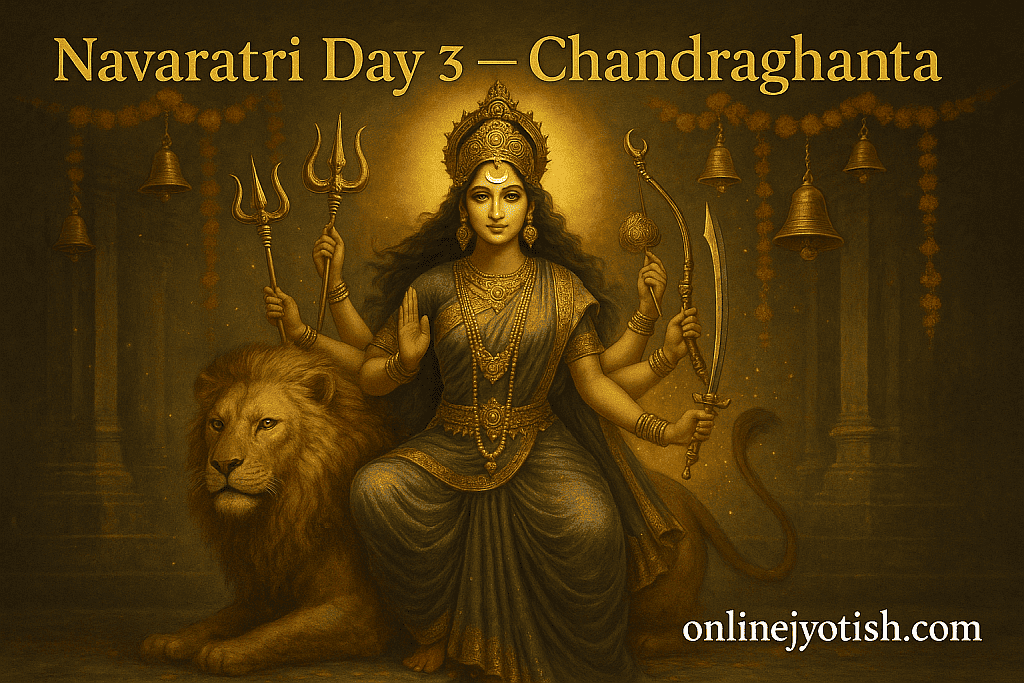
On Day 3 of Navarātri, devotees worship Maa Chandraghanta—the serene yet valiant form of the Divine Mother whose crescent-moon like a bell ( chandra + ghaṇṭā) adorns Her forehead. She is widely depicted with ten arms bearing weapons and boons, mounted on a lion or tiger—signifying courage, protection, and readiness to defend dharma. The alankāra highlights the crescent and the bell motif, with śakti emblems neatly arranged near the image.
Who is Chandraghanta?
- Iconography: Ten-armed Goddess with a crescent on the forehead; commonly shown riding a lion/tiger; hands show mudrā and astras (trident, bow, sword, rosary, etc.).
- Essence: A fusion of tranquility and valor—Her “bell of awareness” awakens steadiness in the mind and dispels inner fear. Traditional descriptions emphasize serenity coupled with swift protection of devotees.
- Mantra: ॐ देवी चन्द्रघण्टायै नमः — Oṃ Devī Candraghaṇṭāyai Namaḥ.
Alankāra (Temple & Home) — Practical Cues
- Focus motifs: Crescent-moon on the forehead and bell motif ( ghaṇṭā) placed near the Goddess; śakti weapons arranged respectfully.
- Attire & tone: Sober yet dignified—devotees often choose calm palettes. Community “color-of-the-day” charts vary by region and year; treat colors as symbolic, not prescriptive.
- Bhāva: Peace-with-power. Maintain a quietly luminous altar, with the bell placed for ārati and mindful ringing.
Puja Vidhi (Simple, Authentic & Doable)
Mantra-japa: A fixed count of “Om Devi Chandraghantayai Namah.” Offer flowers (many sources mention jasmine/yellow/white), light a steady lamp, and keep the worship minimal but attentive. Community guides commonly suggest white sweets like kheer or milk offerings and a satvik naivedya.
Vidhi snapshot: Morning snāna & sankalpa → Ghatasthāpana already done on Day 1 → invoke Chandraghanta with avāhana → offer gandha, akṣata, pushpa, dhūpa, dīpa → recite stotra/mantra → naivedya (light, satvik) → kṣamāprārthanā. (Local customs vary; align with one’s family/temple tradition.)
From Day 2 to Day 3 — The Inner Bridge
Day 2’s Brahmachāriṇī stabilizes the seeker through tapas (vow, discipline). Day 3’s Chandraghanta “rings the bell” of alert courage—turning that discipline into poised fearlessness in daily life.
Where Navarātri is Celebrated on a Grand Scale
Navarātri is pan-Indian, but a few places are renowned for scale, heritage, or Shakti-peetha sanctity:
- Mysuru (Sri Chamundeshwari, Karnataka) — State festival “Mysuru Dasara” with palace/Chamundi Hill inaugurals, cultural programs, exhibitions and the famed Vijayadashami Jumboo Savari.
- Shri Mata Vaishno Devi, Katra (J&K) — Sharad Navarātri draws heavy pilgrim footfall; Shrine Board coordinates special arrangements and ārati.
- Kamakhya Temple, Guwahati (Assam) — Durga Puja/Navarātri observed in a distinctive Śākta rhythm with regional customs.
- Ambaji & Pavagadh (Gujarat) — Among Gujarat’s Shakti-peetha circuits; massive garba traditions and fairs through Navarātri.
- Madurai Meenakshi (Tamil Nadu) — Classic Golu (dolls) displays, daily alankāram and state-listed festivities.
- Kolkata — Kalighat & Dakshineswar (West Bengal) — The heartland of Durga Puja; temple visits surge during Navarātri/Durga Puja.
- Naina Devi Ji, Bilaspur (Himachal Pradesh) — A famed Shakti-peetha; temple extends darshan timings during Navratras and hosts seasonal fairs.
Takeaways for Sādhana (Day 3)
- Be calmly brave: Keep a short bell-ring before ārati to “call the mind to presence.”
- Let offerings be simple: light sweets/white items, flowers, and consistent mantra—depth over display.
- Color is symbolic: wear what aids concentration; community charts differ by source and year.
References & Further Reading
- Chandraghanta iconography (temple handbooks and classical Navadurga summaries).
- Puja ideas & suggested offerings (community and temple guides across regions).
- Mysuru Dasara — official/state information portals.
- Vaishno Devi Shrine Board — Navratri pages.
- Kamakhya Temple — festival notes.
- Gujarat Tourism — Navratri, Ambaji, Pavagadh.
- Tamil Nadu Tourism — Navaratri/Golu at Meenakshi Temple.
- Kolkata temple references — Kalighat & Dakshineswar; Durga Puja season resources.
- Naina Devi — temple/government information portals.
About the Author

Santhosh Kumar Sharma Gollapelli is a Vedic Astrologer and the founder of OnlineJyotish.com (est. 2004). He develops multilingual Panchangam & festival calculators with Swiss-Ephemeris and classical Dharmashāstra rules, and writes practical guides connecting śāstra with daily life.
Reviewed for alignment with common temple practice and standard references.

 Want to find a good partner? Not sure who is the right match? Try Vedic Astrology! Our Star Matching service helps you find the perfect partner. You don't need your birth details, just your Rashi and Nakshatra. Try our free Star Match service before you make this big decision!
We have this service in many languages:
Want to find a good partner? Not sure who is the right match? Try Vedic Astrology! Our Star Matching service helps you find the perfect partner. You don't need your birth details, just your Rashi and Nakshatra. Try our free Star Match service before you make this big decision!
We have this service in many languages:
 Are you interested in knowing your future and improving it with the help of KP (Krishnamurti Paddhati) Astrology? Here is a free service for you. Get your detailed KP birth chart with the information like likes and dislikes, good and bad, along with 100-year future predictions, KP Sublords, Significators, Planetary strengths and many more. Click below to get your free KP horoscope.