
Use accurate birth records
Enter the local birth date, exact time and birthplace for both people. Timezone or daylight-saving errors can change the Ascendant and houses.

This service calculates Ashtakoota Guna Milan and reviews the Mangal Dosha, Nadi, Bhakoot, Gana, Graha Maitri and other matching conditions implemented in the report.
It is a traditional astrology framework—not a medical, genetic, psychological or scientific test of whether a relationship will succeed.
Enter the local birth date, exact time and birthplace for both people. Timezone or daylight-saving errors can change the Ascendant and houses.
Do not rely only on the total Guna score. Read Nadi, Bhakoot, Graha Maitri, Gana, Mangal Dosha and the chart-based observations.
The two adults’ informed consent, communication, values, health, safety and practical expectations matter more than any calculated score.
Check the names, birth dates, local birth times, cities and timezones before generating the report.
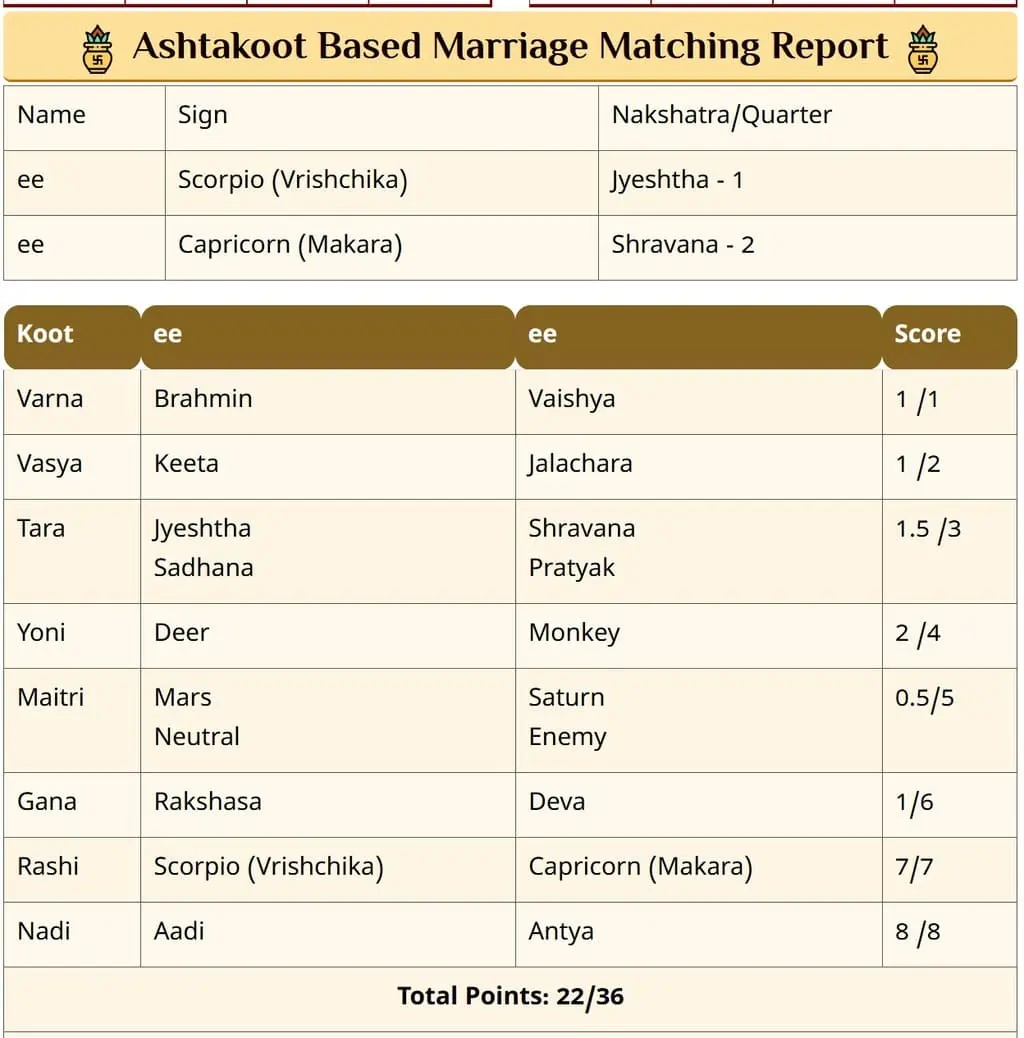
The generated report may contain the displayed score table, Dosha sections and explanatory text. Content can vary with the submitted charts.
Calculates the traditional eight Kootas—Varna, Vashya, Tara, Yoni, Graha Maitri, Gana, Bhakoot and Nadi—with a maximum total of 36 points.
Reviews the Mars placements used by this service and compares the two charts for Dosha Samya and available traditional exceptions.
Shows the traditional Nadi and Moon-sign relationship results. These are astrological classifications, not medical or genetic tests.
Compares traditional temperament groups and the relationship between the rulers of the two Moon signs.
Checks available Eka Nakshatra conditions and the exceptions implemented by the matching engine.
Reports the traditional Gatha or Vedha-type Nakshatra conditions included in this version of the service.
Where available, the report also presents chart-based factors beyond the Nakshatra score, including relevant house and planetary considerations.
Presents the calculated score, individual Koota results and the stated balancing rules so that the user can review each factor separately.
A total such as 18 or 25 is a summary of eight traditional categories. It should not be treated as a pass/fail verdict.
Nadi is a Nakshatra classification. It does not test genes, fertility, pregnancy outcome or the future health of children.
These are symbolic Moon-sign and temperament factors. They do not prove conflict, separation or emotional incompatibility.
A traditional exception changes the weight assigned by that rule set. It does not guarantee a happy marriage or erase practical concerns.
The Ashtakoota system assigns a maximum of 36 points across eight categories: Varna, Vashya, Tara, Yoni, Graha Maitri, Gana, Bhakoot and Nadi. The total is a traditional summary score, not a scientific measurement of relationship success.
No. Many traditions use 18 points as a general reference, but it is not a legal, medical or scientifically validated pass mark. The individual Kootas, the full charts and the couple’s real circumstances should also be considered.
No. Consent, communication, shared values, emotional safety, health, finances, family expectations and day-to-day behaviour are more important than an astrological score.
The presence of Mangal Dosha does not automatically prohibit marriage. Traditional astrologers may compare both charts, Dosha Samya, sign and house placement, aspects and stated exceptions before forming an opinion.
No. A traditional exception may reduce the weight assigned to a Mars placement within a particular method, but it does not guarantee compatibility or cancel real relationship concerns.
No. Nadi is a traditional Nakshatra classification. It is not a DNA test, fertility assessment or medical prediction. Couples with health or hereditary concerns should consult qualified medical professionals and use appropriate screening.
No certain event can be concluded from Bhakoot alone. It is calculated from the relationship between the two Moon signs and should be read as one traditional factor among many.
Star Matching is a limited Rashi–Nakshatra comparison. A fuller birth-chart review may include Lagna, the seventh house, Venus, Jupiter, Mars, Dashas and other factors, but even that does not replace real-world compatibility.
Birth time and place are needed to calculate the Ascendant, houses, planetary positions and time-sensitive chart factors. An incorrect timezone, daylight-saving setting or birth time can change the report.
No. It is a traditional astrology report for reflection. The decision must remain with the two informed, consenting adults, taking account of safety, health, values, expectations and practical circumstances.

This page and its matching framework are maintained under the guidance of Santhosh Kumar Sharma Gollapelli and use traditional Vedic horoscope-matching principles.
OnlineJyotish was developed to make chart calculations more accessible after the practical difficulty of preparing horoscopes manually. The service has been offered for 26 years.
Read the background and methodology →
For those who want a complete birth horoscope, OnlineJyotish.com offers Exclusive and Premium Janmakundali reports. This comprehensive horoscope contains more than 400 pages, including detailed analysis of every house; special insights into education, health, marriage, children, career, fortune and life purpose; complete details of yogas, doshas and remedies; Shadvarga results; planetary Avastha interpretations; Ashtakavarga analysis and predictions; Vimshopaka Bala and its results; Dasha, Antardasha and Pratyantardasha predictions covering 100 years; transit dates of Jupiter, Saturn, Rahu and Ketu for 100 years; and detailed transit predictions of Jupiter, Saturn, Rahu and Ketu for the next 10 years, along with many more special features. It is a comprehensive 400+ page Brihat Janmakundali. Click below to receive your complete horoscope within moments.