

Original vs. Fake Rudraksha: A Complete Identification Guide
Genuine Rudraksha shows continuous mukhi lines from one pole to the other and a natural internal structure. Clever fakes may be carved, glued, molded, or dyed—so the safest route is a lab X-ray report from a recognized gem testing lab, plus a few simple non-destructive checks you can do yourself.
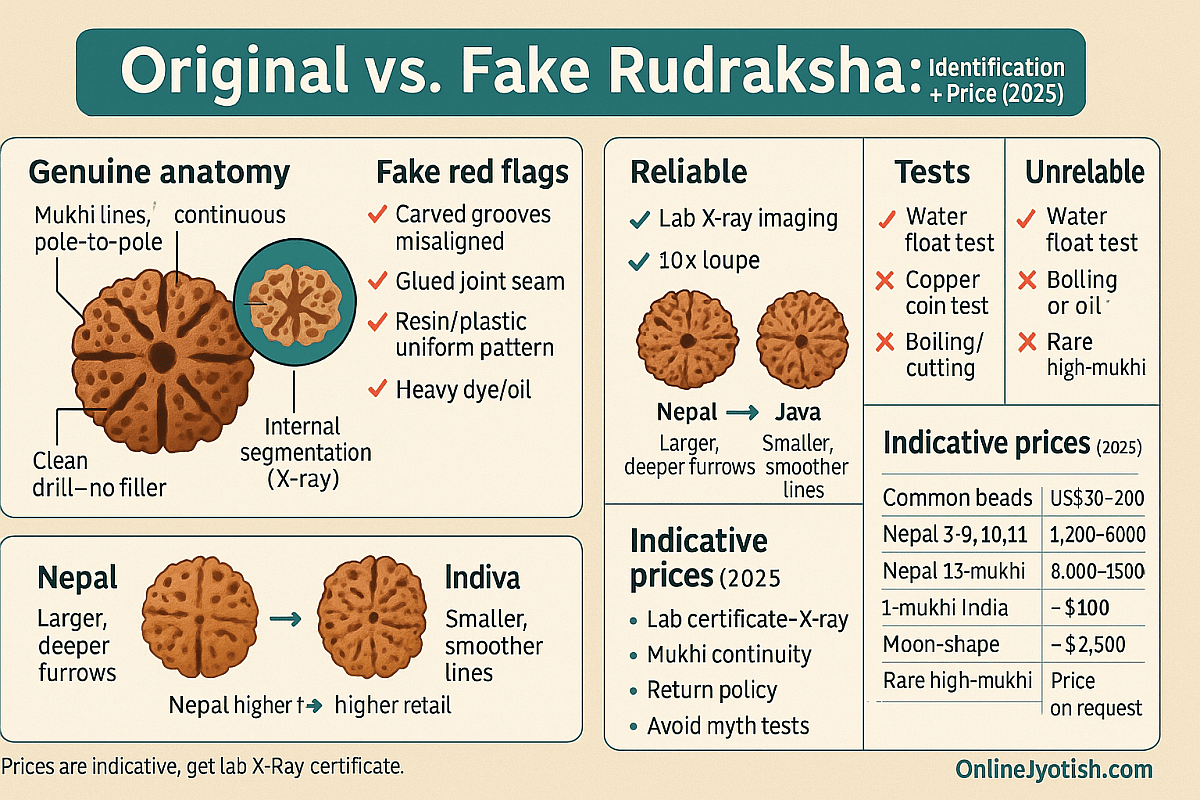
Anatomy of a Genuine Rudraksha
- Mukhi lines: Natural, unbroken ridges running from one “pole” to the other. Carved fakes often show machining marks, shallow grooves, or lines that don’t meet at both poles.
- Surface: Nepal beads are typically larger with deeper furrowed lines; Java beads are smoother with thread-like lines. Both can be genuine.
- Internal structure: X-ray imaging shows natural radial segmentation consistent with mukhi formation and reveals hidden joints (glued/assembled beads).
- Drill hole: Clean, centered drilling with natural tissue visible; watch for resin, fillers, or “sandwich” joints inside the hole.
Common Fake/Tampered Types
- Carved mukhi: Extra grooves cut to inflate the mukhi count; or grooves disguised/filled to reduce count. This is widespread in tourist markets.
- Joined beads: Two halves glued to mimic rare forms (e.g., Gauri Shankar/Trijuti) or to fake high mukhi. X-ray typically catches the seam.
- Resin/wood/plastic molds: Too light, uniform texture, or repeating “patterns.” Simple magnification often exposes these.
- Dyed/oiled aging: Tea/coffee/oil used to darken; not a sign of age or power—just cosmetics.
Tip: Ask the seller to declare in writing that mukhi lines are natural and unaltered—and that the bead hasn’t been carved, joined, dyed, or resin-stabilized.
Reliable vs. Unreliable Tests
| Test | What it tells you | Reliability | Notes |
|---|---|---|---|
| Lab X-ray / imaging | Shows natural internal segmentation; reveals carved grooves, glued joints, and anomalies | High | Use recognized gem labs (sample formats from IGL; GTL lists analytical methods). |
| 10× loupe inspection | Surface texture, continuity of mukhi lines, tool marks, resin | Medium | Good first filter; not conclusive for advanced fakes. |
| Weight/size symmetry | Flags suspiciously light/too-uniform pieces | Medium | Use alongside loupe and documentation. |
| Water float/sink | Density only (affected by age, oiling, dryness) | Low | Not proof of authenticity. Prefer lab imaging. |
| Copper coin “magnetism” | Folk belief; no scientific basis | Low | Avoid; rely on imaging/certificates instead. |
| Boiling/cutting | Damaging; may ruin a genuine bead | Do not use | Non-destructive testing only. |
Certification & Lab Reports (What to ask for)
- Imaging included: Ask for an X-ray/CT style image in the certificate (several Indian labs provide passport/folder reports with X-ray and size/weight).
- Lab credibility: Prefer established gem testing labs (e.g., GTL Jaipur lists analytical methods; check history and disclosure policy).
- Details on report: Mukhi count, dimensions (mm), weight, origin claim (where stated), bead photos, unique report number, and packaging seals.
- Government “BIS” note: BIS compulsion applies to specific product categories; there’s no universal BIS mandate for Rudraksha. Choose reputed labs and transparent sellers.
Nepal vs. Java (What’s the difference?)
Nepal beads tend to be larger with deeper, furrowed lines and thorny projections; Java (Indonesian) beads are generally smaller, smoother, with thread-like mukhi lines. Both are authentic species of Elaeocarpus and both work for sādhanā—pricing and aesthetics differ.
Price Analysis (Indicative 2025 Retail Ranges)
Prices vary by origin (Nepal vs Java), size (mm), symmetry, surface, certification, and rarity of the mukhi. The examples below reflect publicly listed retail prices from established online sellers as of 2024–2025; your local quotes may differ.
| Type (single bead) | Java (Indonesia) | Nepal | Sources |
|---|---|---|---|
| Common beads (e.g., 3–9 mukhi) | Often in the lower band of “common beads” (USD 30–200)* | Typically higher than Java for same mukhi/size | *Seller FAQ range for “common beads”. |
| Examples (Nepal) – 3, 9, 10, 11, 13 mukhi | — | Listed around ₹1,200–₹6,000 for 3/9/10/11; ₹8,000–₹15,000 for 13 | Store listings (India). |
| 1 mukhi (India/“moon shape” vs Nepal rare forms) | — | India “moon-shape” may list near $100; Nepal “moon-shape” examples near $2,500; round Nepal 1-mukhi is exceptionally rare | Store pages showing $100 (India) and $2,500 (Nepal). |
| High mukhi (15–21), rare forms (Gauri Shankar/Trijuti) | Price varies widely; Java often lower than Nepal | Premium/collector pricing; some items “call for price” | Representative listings show “call for price” on rare Nepal pieces. |
Why the spread? Sellers grade by origin, mm size, symmetry, surface clarity, and documentation; curated malas/sets (e.g., Siddha/Brahma malas) cost substantially more than single beads.
Buying Checklist (Save & screenshot)
- Ask for a lab certificate with X-ray/CT image and unique report number.
- Inspect mukhi continuity from pole to pole under 10×; avoid tool marks and filled grooves.
- Prefer Nepal for larger, deeper lines (costs more); Java is a budget-friendlier genuine option.
- Skip float/coin myths; they do not prove authenticity.
- Confirm return policy and originality guarantee in writing.
Care & Maintenance
- Keep dry and clean; avoid prolonged soaking or harsh detergents.
- Light oiling (once in a while) to prevent cracking; wipe excess.
- Re-string malas annually; check drill holes for wear/fillers.


 Are you interested in knowing your future and improving it with the help of Vedic Astrology? Here is a free service for you. Get your Vedic birth chart with the information like likes and dislikes, good and bad, along with 100-year future predictions, Yogas, doshas, remedies and many more. Click below to get your free horoscope.
 Are you interested in knowing your future and improving it with the help of KP (Krishnamurti Paddhati) Astrology? Here is a free service for you. Get your detailed KP birth chart with the information like likes and dislikes, good and bad, along with 100-year future predictions, KP Sublords, Significators, Planetary strengths and many more. Click below to get your free KP horoscope.