

Geocentric vs Topocentric Calculations: Precision in Astrology
Panchangam, Horoscopes, and Muhurthas—all of these are based on planetary positions. When calculating these positions, two primary methods are used: Geocentric and Topocentric. While the difference might seem minor, it can be influential enough to change a decision in boundary cases.
1) Geocentric Calculation
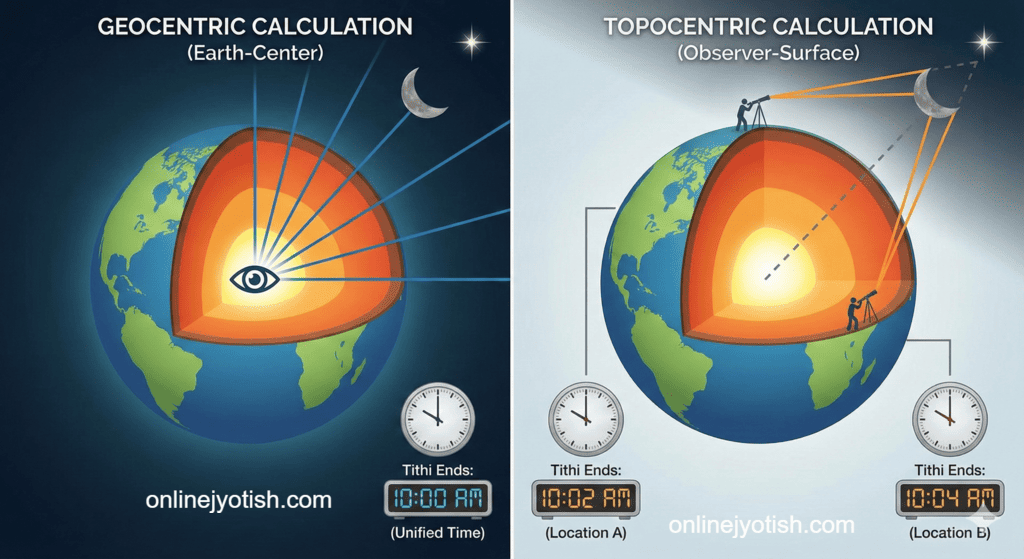
Geocentric means "Earth-centered." This method calculates planetary positions from the center of the Earth. This is the standard practice for the vast majority of traditional Panchangams.
- Standardization: Most panchangams worldwide follow this method for consistency.
- Timing: The Tithi/Nakshatra "ending moment" in geocentric is the same globally—it only appears differently when converted to your local time zone.
- Usage: Ideal for festivals, Vratas, general panchangam information, and daily spiritual needs.
2) Topocentric Calculation
Topocentric means "Surface-centered" or "Observer-centered." Here, planetary positions are calculated from your exact location (Observer’s latitude, longitude, and elevation) rather than the Earth's center.
- Parallax Effect: When viewing from the Earth's surface, the apparent position of celestial objects shifts slightly. This shift is most significant for the Moon and negligible for the Sun. (The Moon's maximum diurnal parallax is about 57′; the Sun's is only about 8.8″.)
- Why the Moon matters: Because the Moon is closest to Earth, the observer's position significantly changes its apparent placement against the stars. This can cause Tithi and Nakshatra end times to vary by a few minutes.
- The Variance: Typically, you might see a difference of 1 to 4 minutes (sometimes slightly more), which is crucial when an event occurs very close to a time boundary.
| Feature | Geocentric | Topocentric |
|---|---|---|
| Center of Calculation | Center of the Earth | Your exact location (Lat/Long/Elev) |
| Ending Moments | Global moment (standardized) | Varies by city (by a few minutes) |
| Best Use Case | General Panchangam, Festivals | Precise Horoscopes, KP, Boundary Decisions |
3) When does the difference truly matter?
On most days, this difference won't affect your daily routine. However, in the following scenarios, a "few minutes" can change the entire outcome:
- Tithi/Nakshatra Boundaries: Deciding the start of a Vrata, Parana times, or fasting rules for Ekadashi/Pradosha when the change happens near sunrise.
- KP Astrology: Since KP relies heavily on timing-sensitive sub-lords, observer-based precision is often preferred.
- Planets at House Cusps: If a planet (especially the Moon) is at the very edge of a house (Bhava), a topocentric calculation might move it to the next house.
- Eclipses and Moonrise/set: These are naturally "observer phenomena." Topocentric factors, including altitude and atmospheric refraction, are vital here.
4) Data Requirements for Topocentric
5) Technical Insight (For Advanced Readers)
- Parallax: This is the apparent displacement of an object when viewed from two different points. In astrology, it accounts for the distance between the Earth's center and the observer's eye.
- In high-end engines like the Swiss Ephemeris, certain points (like Lunar Nodes or the Apogee) are usually treated as geocentric by default unless specified otherwise.
6) Which should you use? A Simple Rule
- For general Panchangam and festivals: Geocentric is the standard and perfectly sufficient.
- For "Minute-to-Minute" precision: Choose Topocentric, especially for KP Astrology, Muhurtha boundary decisions, and Eclipse/Moonrise timings.
Frequently Asked Questions (FAQ)
Conclusion
In summary: Geocentric is the reliable standard for general astrology. Topocentric offers localized precision, especially for Lunar timing boundaries, KP Astrology, and Muhurtha.
On OnlineJyotish.com, you can select your preferred calculation method when generating your Panchangam or Horoscope. To see how your horoscope changes using the Topocentric method, Click Here.

 If you're searching for your ideal life partner and struggling to decide who is truly compatible for a happy and harmonious life, let Vedic Astrology guide you. Before making one of life's biggest decisions, explore our free marriage matching service available at onlinejyotish.com to help you find the perfect match. We have developed free online marriage matching software in
 Want to find a good partner? Not sure who is the right match? Try Vedic Astrology! Our Star Matching service helps you find the perfect partner. You don't need your birth details, just your Rashi and Nakshatra. Try our free Star Match service before you make this big decision!
We have this service in many languages:
Want to find a good partner? Not sure who is the right match? Try Vedic Astrology! Our Star Matching service helps you find the perfect partner. You don't need your birth details, just your Rashi and Nakshatra. Try our free Star Match service before you make this big decision!
We have this service in many languages: