
Use the best birth-time record
Cuspal degrees and sub-lords can change with a small time difference near a boundary.

Enter the birth date, local time and birthplace to generate the KP calculations available in the report, including cusps, planetary star and sub-lords, significators and Ruling Planets.
The result is a traditional analytical framework, not a guarantee that an event will occur.
Cuspal degrees and sub-lords can change with a small time difference near a boundary.
Latitude affects cusp division, while longitude and timezone affect the local-time conversion.
Record the Ayanamsha, node type, house system and Geocentric or Topocentric option when comparing reports.
Use local clock time as recorded; do not manually convert it to UTC.
The degree of each house cusp with its sign lord, star lord and sub-lord where supplied by the report.
The sign, Nakshatra lord and sub-lord of each calculated planet.
A structured table showing the houses connected with planets under the significator rules implemented by the engine.
The available weekday, Ascendant and Moon-related ruling factors for the time of judgment or report generation.
A house-cusp presentation used alongside the sign chart to review where planets fall by the selected house system.
Available planetary periods can be read with significators as a traditional timing framework.
The form may allow the user to choose the reference point used for sensitive calculations.
The report may include supporting tables for chart study, depending on the current version and selected options.
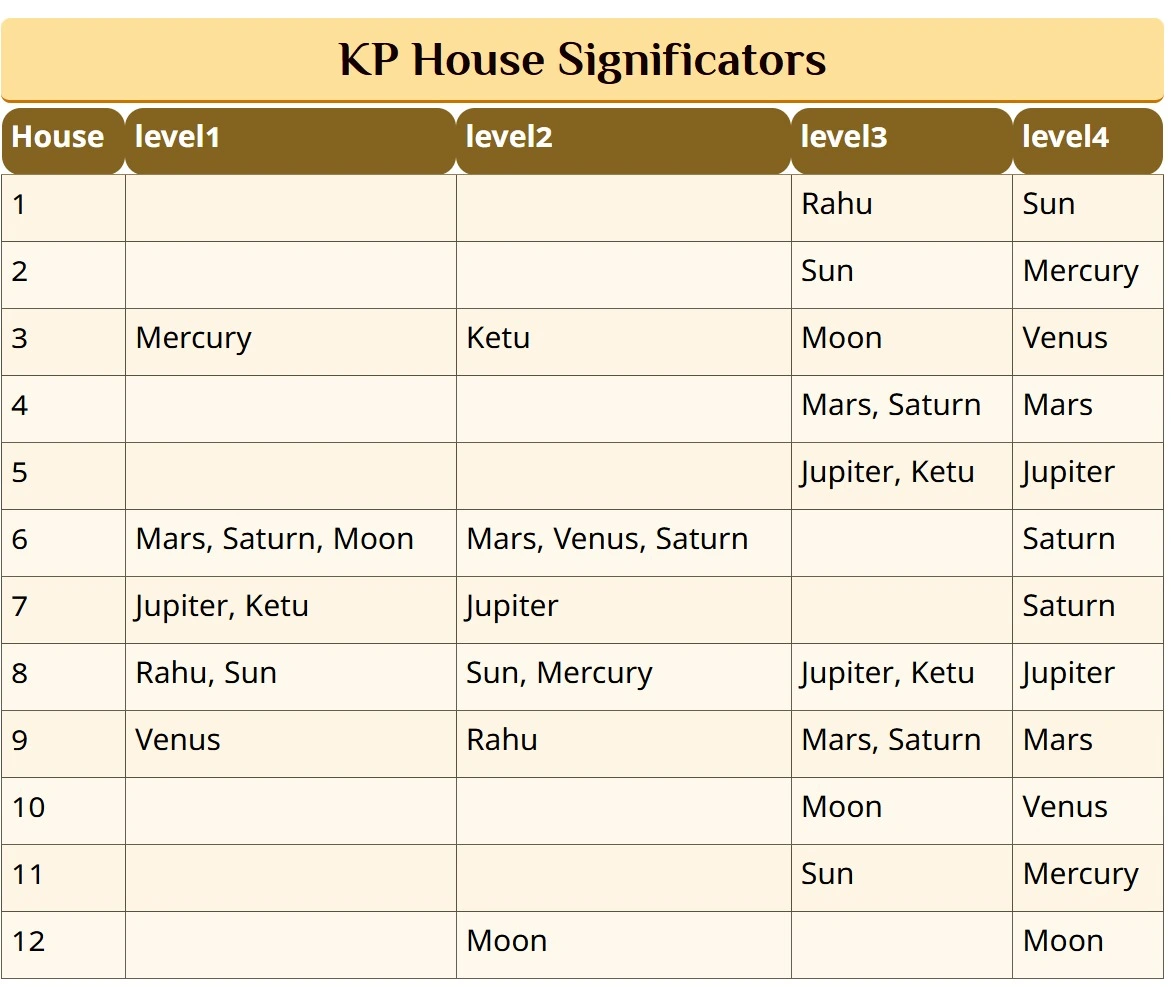
The exact tables shown can vary with the current report version and selected options.
Each house cusp is read through its degree, sign lord, star lord and sub-lord under the selected house system.
The ruler of the Nakshatra occupied by a planet or cusp is used as an important significating factor.
The ruler of the smaller Vimshottari-proportioned segment within a Nakshatra is used as a finer interpretive factor.
The report organises the houses connected with planets according to the implemented occupation, ownership and star-level rules.
These are supporting factors associated with the weekday, Ascendant and Moon at the time used by the report.
Dashas, significators and transits can be combined as a traditional timing method, but do not prove an event.
KP or Krishnamurti Paddhati is an astrology system associated with Prof. K.S. Krishnamurti. It gives special importance to house cusps, Nakshatra lords, sub-lords and significators.
Each 13°20′ Nakshatra is divided into nine unequal portions according to the Vimshottari Dasha proportions. The ruler of the portion occupied by a planet or cusp is called its sub-lord.
The star lord is the ruler of the Nakshatra occupied by the planet or cusp. The sub-lord is the ruler of the smaller Vimshottari-proportioned segment within that Nakshatra.
Cusp degrees and sub-lords can be highly time-sensitive. A small birth-time error can change a cusp sub-lord, especially near a boundary. Latitude, longitude and timezone also affect the house calculation.
KP commonly uses a cusp-based house system such as Placidus. A planet can remain in the same sign while its calculated house differs from a whole-sign or another house presentation.
No universal accuracy guarantee can be made. Usefulness depends on birth-time quality, calculation settings, the rule set and the astrologer’s interpretation.
In KP practice, Ruling Planets are used as supporting factors in Horary work, timing judgments and birth-time verification. They should not be treated as proof on their own.
Geocentric calculation uses the Earth’s centre as the reference point. Topocentric calculation uses the observer’s location on the surface. Sensitive values can differ slightly.
Differences can arise from KP Ayanamsha version, node type, house system, geocentric or topocentric settings, coordinates, timezone data, rounding and significator rules.
No. It presents traditional astrological factors. Real events depend on circumstances, decisions, timing accuracy and many non-astrological factors.
No. Use it for traditional astrology study and reflection. High-stakes decisions require qualified professional advice and reliable facts.

This KP page and its explanatory content are maintained under the guidance of Santhosh Kumar Sharma Gollapelli.
Read the background and methodology →
For those who want a complete birth horoscope, OnlineJyotish.com offers Exclusive and Premium Janmakundali reports. This comprehensive horoscope contains more than 400 pages, including detailed analysis of every house; special insights into education, health, marriage, children, career, fortune and life purpose; complete details of yogas, doshas and remedies; Shadvarga results; planetary Avastha interpretations; Ashtakavarga analysis and predictions; Vimshopaka Bala and its results; Dasha, Antardasha and Pratyantardasha predictions covering 100 years; transit dates of Jupiter, Saturn, Rahu and Ketu for 100 years; and detailed transit predictions of Jupiter, Saturn, Rahu and Ketu for the next 10 years, along with many more special features. It is a comprehensive 400+ page Brihat Janmakundali. Click below to receive your complete horoscope within moments.