
Use the recorded local time
Do not manually convert the birth time to UTC. Enter the local clock time shown in the birth record.

Enter the birth date, local birth time and birthplace to calculate your Rashi (sidereal Moon sign), Janma Nakshatra (birth star), Pada and naming syllable. The calculation is free and does not require registration.
The result describes the Moon’s calculated position for the submitted details. It does not define a person’s complete identity, personality or future.
Do not manually convert the birth time to UTC. Enter the local clock time shown in the birth record.
The city determines coordinates, timezone and historical daylight-saving rules. Check the country when cities share the same name.
If the Moon is near a Rashi, Nakshatra or Pada boundary, a birth-time difference can change the result.
The same 360° zodiac is divided into 12 Rashis of 30° each and 27 Nakshatras of 13°20′ each. Each Nakshatra has four Padas of 3°20′. A Nakshatra can therefore extend across a Rashi boundary.
Accurate time is especially useful for resolving the Nakshatra Pada and boundary cases.
The sidereal sign occupied by the Moon at birth. It is used for general Rashi readings and several traditional practices.
One of 27 lunar mansions, each spanning 13°20′ of the sidereal zodiac.
One of four equal quarters within the Nakshatra. Each Pada spans 3°20′ and corresponds to a Navamsha division.
In the Vimshottari system, the Nakshatra lord identifies the starting Dasha, while the Moon’s position is used to calculate the balance.
Some families select the first sound of a child’s name from the Nakshatra Pada. This is a cultural practice, not a compulsory rule.
Several Ashtakoota and Dasha Koota factors use the two birth Nakshatras. They do not establish medical, genetic or relationship compatibility.
Daily Rashiphal is commonly organized by Janma Rashi, but it remains a general sign-based reading rather than a personal prediction.
Janma Nakshatra can be considered in Tara Bala and other personalized Muhurta traditions together with the event and full Panchanga.
Janma Rashi is the sidereal zodiac sign occupied by the Moon at the entered birth time and place. It is commonly used in Indian astrology for general Rashi-based readings and several traditional matching or calendar practices.
Janma Nakshatra is the lunar mansion occupied by the Moon at birth. The sidereal zodiac is divided into 27 Nakshatras, each spanning 13°20′.
Each Nakshatra is divided into four equal Padas of 3°20′. The Pada is used in traditional naming syllables and is linked with a Navamsha division.
The Moon moves continuously. A time difference may change the exact lunar degree, Pada and, near a boundary, even the Nakshatra or Rashi. The likelihood depends on how close the Moon was to the relevant boundary.
A date-only estimate may be possible when the Moon remains in one sign or Nakshatra throughout that local day, but the calculator requires a time for a definite result. If the Moon changed during the day, the result cannot be resolved without a more reliable time.
No. A name-based result associates the first sound of a name with a traditional Nakshatra syllable. It is an approximation and does not calculate the Moon’s astronomical position at birth.
The Moon’s Nakshatra identifies the traditional starting Dasha lord, while the Moon’s progress within that Nakshatra is used to calculate the remaining balance at birth.
Many families select an initial sound associated with the Nakshatra Pada. This is a cultural naming practice rather than a compulsory rule or a guarantee of a particular outcome.
No single Nakshatra determines a person’s complete personality or future. A traditional reading may also consider the Moon’s sign and house, its lord, aspects, conjunctions, Lagna, other planets, Vargas and Dashas.
Differences can arise from tropical versus sidereal zodiac, Ayanamsha choice, timezone and daylight-saving data, coordinates, ephemeris settings and rounding near a boundary.
No. The calculation is provided for traditional astrology study and cultural use. It should not be treated as a medical, psychological, legal or financial assessment.

This calculator and its explanatory content are maintained under the guidance of Santhosh Kumar Sharma Gollapelli for traditional Vedic astrology study.
Read the background and methodology →
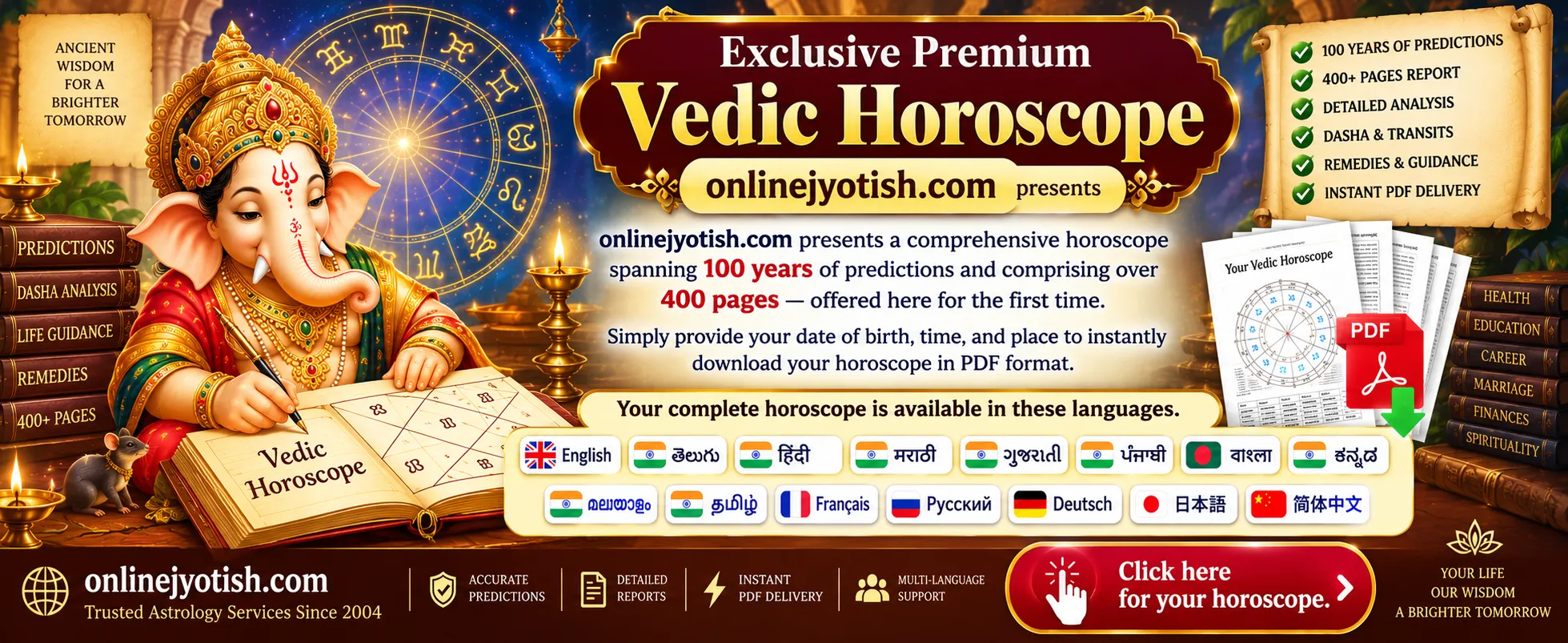
For those who want a complete birth horoscope, OnlineJyotish.com offers Exclusive and Premium Janmakundali reports. This comprehensive horoscope contains more than 400 pages, including detailed analysis of every house; special insights into education, health, marriage, children, career, fortune and life purpose; complete details of yogas, doshas and remedies; Shadvarga results; planetary Avastha interpretations; Ashtakavarga analysis and predictions; Vimshopaka Bala and its results; Dasha, Antardasha and Pratyantardasha predictions covering 100 years; transit dates of Jupiter, Saturn, Rahu and Ketu for 100 years; and detailed transit predictions of Jupiter, Saturn, Rahu and Ketu for the next 10 years, along with many more special features. It is a comprehensive 400+ page Brihat Janmakundali. Click below to receive your complete horoscope within moments.