

Vastu Shastra · Home
The Puja room is a home's spiritual nucleus—a sanctified, light-filled zone. Classical Vāstu favors the Northeast (Īśānya) for sacred activity, with devotees ideally facing East. The guidance below balances timeless principles with modern layouts, apartment living, and essential safety.
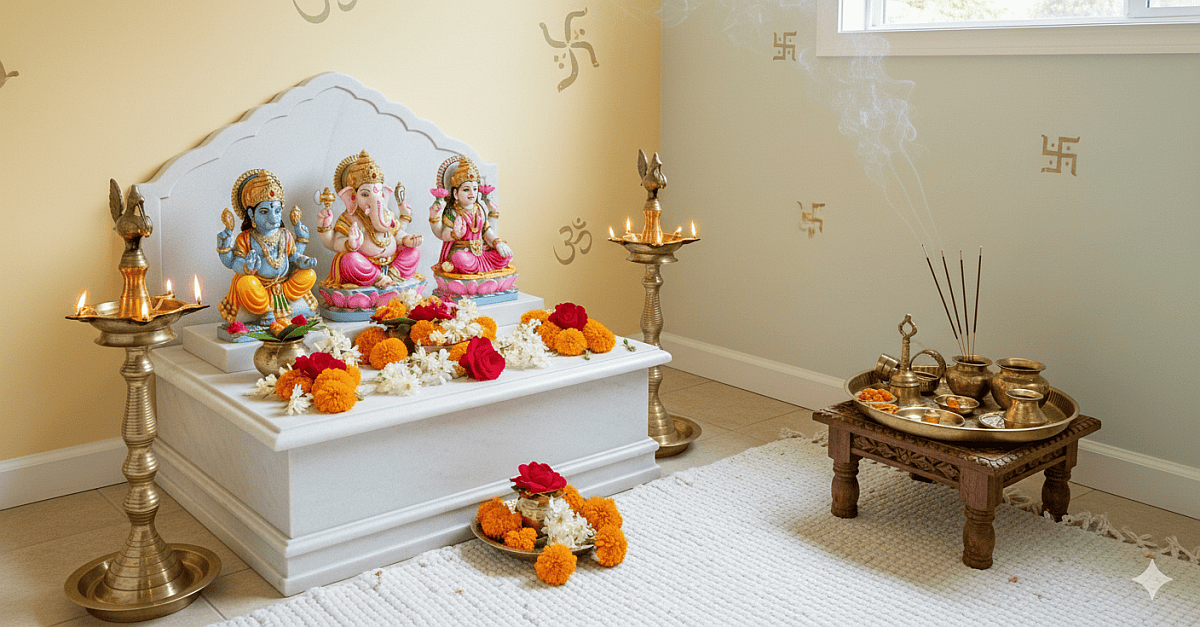
1) Direction & Location
- Ideal zone: Northeast (Īśānya). This corner is considered the source of divine energy. Alternatives include the East or North zones. Avoid the heavy South-West corner for a primary Puja room.
- Center (Brahmasthān): Keep the center of the home free of heavy objects to allow energy to circulate. A small, light Puja space can be located here if the architecture allows.
- Adjacent areas: Avoid placing a Puja room directly next to or sharing a wall with a bathroom or kitchen. If unavoidable, ensure there is no plumbing on the shared wall and maintain impeccable hygiene.
2) Altar, Deity & Seat (Āsana)
- Devotee orientation: Always face East (for enlightenment) or North (for prosperity) while praying.
- Deity placement: Place mūrtis or frames on the East or West wall, so devotees naturally face the correct direction. Keep a small gap (≈ 2–6 cm) behind idols for air circulation.
- Idol specifics: Idols should ideally not be taller than 9 inches. Ensure they are not cracked or broken. It is advised not to keep more than one idol of the same deity, especially Ganesha, in the same mandir.
- Altar materials: Wood (like Teak or Sandalwood) and Marble are considered the most auspicious materials for a mandir. Avoid glass or plastic as primary materials.
- Heights: The base of the idols should be at the devotee's chest level when seated. The altar platform should be at a comfortable height.
- Ancestor photos: Keep photos of departed ancestors separate from the principal altar. Place them respectfully on a South-facing wall elsewhere in the home.
3) Room Layout, Sizing & Storage
- Size guide: A dedicated Puja room should be spacious enough for family members to sit comfortably without feeling cramped. For a niche, ensure enough space for offerings and an āsana.
- Storage: Keep scriptures and puja samagri in covered cabinets located on the South or West walls. Avoid cluttering the sacred Northeast corner with storage.
- Doors & windows: A two-shutter door is traditional and ideal. If possible, have a window in the North or East for beneficial morning sunlight.
- Ceiling: A simple, flat ceiling is best. Avoid placing the main altar directly under a heavy structural beam. If unavoidable, a false ceiling or light canopy can mitigate the effect.
4) Lamp, Water, Incense & Elements
- Lamp (Dīya): The sacred fire (Agni) should be placed in the Southeast quadrant of the altar. Use a stable brass or stone lamp on a non-flammable tray.
- Water (Kalash/Urli): Keep sacred water in a vessel at the Northeast of the room or altar. Change the water and flowers daily.
- Incense/Camphor: Use natural, mild fragrances. Ensure good ventilation after āratī to clear smoke. Store matches and camphor safely away from the Northeast.
5) Colors, Lights, Ventilation & Acoustics
- Palette: White, off-white, light yellow, sandalwood, or other pale, sattvic colors are best. Avoid dark colors like black, dark blue, or harsh reds.
- Lighting: Use warm, gentle lighting. A small focus light on the altar can enhance the divine atmosphere, complemented by ambient light in the room.
- Ventilation: Fresh air flow is vital. An open window or a quiet exhaust fan helps clear smoke and keeps the prāṇa (life-force energy) fresh.
- Sound: The space should be peaceful. Use a small rug to absorb sound and prevent echo. The soft sound of a bell is considered auspicious.
6) Apartment/Rental Remedies
- Wall-mandirs: A compact wooden or marble unit mounted on the Northeast wall of the living or dining room is an excellent solution. A curtain can be used for privacy.
- Northeast blocked: If the NE is unavailable, create a clean, dedicated corner in the East or North zone of your home.
- Partitions: Use a decorative screen (jali) or a bookshelf to create a visual separation and maintain the sanctity of the Puja space if it's in a multi-purpose room.
7) Do’s, Don’ts & Safety
- ✔ Keep the Puja space spotlessly clean and clutter-free.
- ✔ Remove faded flowers and offerings daily.
- ✔ Store puja items neatly in covered storage.
- ✔ Ensure smoke/CO alarms in your home are functional.
- ✘ Don’t place the altar directly under a beam or staircase.
- ✘ Don’t place idols where they directly face a bathroom door.
- ✘ Don’t use strong, artificial fragrances that can be distracting.
- ✘ Don’t store heavy or unnecessary items in the Puja room.
Fire Safety: Never leave an open flame unattended. Keep the lamp away from curtains, papers, and flammable materials. Always use a non-flammable tray underneath.
8) Quick Placement Map
| Element | Direction / Zone | Notes |
|---|---|---|
| Main Puja Area | Northeast (ideal) → East/North (backup) | Keep uncluttered and bright |
| Devotee Facing | Face East (preferred) or North | Seat (āsana) aligned accordingly |
| Lamp (Dīya) | Altar’s Southeast quadrant | Stable base, safety first |
| Water/Kalash | Northeast of room/altar | Change daily; no spills |
| Storage (books/samagri) | South/West walls | Keep Northeast free |
| Ancestor Photos | Separate area; on a South wall | Not on the main altar with deities |
Printable Checklist
- ✔ Direction is Northeast, East, or North of the home.
- ✔ Altar placed so devotees face East/North; small gap behind idols.
- ✔ Lamp in the SE of the altar on a safe, stable tray.
- ✔ Fresh water and flowers in the NE of the altar.
- ✔ Storage is on South/West walls, keeping the NE corner light.
- ✔ No broken idols, no ancestor photos on the main altar.
- ✔ Partition or curtain used for privacy in shared spaces.
- ✔ Area is clean, well-ventilated, and free of clutter.
FAQs
Which direction is best for a Puja room?
Northeast (Īśānya) is ideal. If not feasible, East or North works well. The Northeast corner of the home should be kept light and clean regardless of where the mandir is.
Which way should I face while praying?
You should face East (preferred) or North while praying. Therefore, the deities should be placed on the altar so that devotees naturally face these auspicious directions.
Can the Puja room be in a bedroom or kitchen?
Yes, if space is limited, but with strict rules. The Puja area must have a partition (like a curtain or screen) for sanctity, especially in a bedroom. The mandir's location should not align with the foot of the bed. In a kitchen, keep it far from the stove and sink, and ensure the area is always kept clean.
What are safe lighting options for the lamp (dīya)?
Use a stable brass lamp on a non-flammable tray. For apartments or homes with children, consider enclosed lamps or high-quality LED dīyas for enhanced safety. Always keep lamps away from curtains and ensure smoke alarms are functional.


 If you're searching for your ideal life partner and struggling to decide who is truly compatible for a happy and harmonious life, let Vedic Astrology guide you. Before making one of life's biggest decisions, explore our free marriage matching service available at onlinejyotish.com to help you find the perfect match. We have developed free online marriage matching software in
 Are you searching for a detailed Panchang or a daily guide with good and bad timings, do's, and don'ts? Our daily Panchang service is just what you need! Get extensive details such as Rahu Kaal, Gulika Kaal, Yamaganda Kaal, Choghadiya times, day divisions, Hora times, Lagna times, and Shubha, Ashubha, and Pushkaramsha times. You will also find information on Tarabalam, Chandrabalam, Ghata day, daily Puja/Havan details, journey guides, and much more.