Regional and Time Rules Based on Dharmashastra and Muhurta Texts
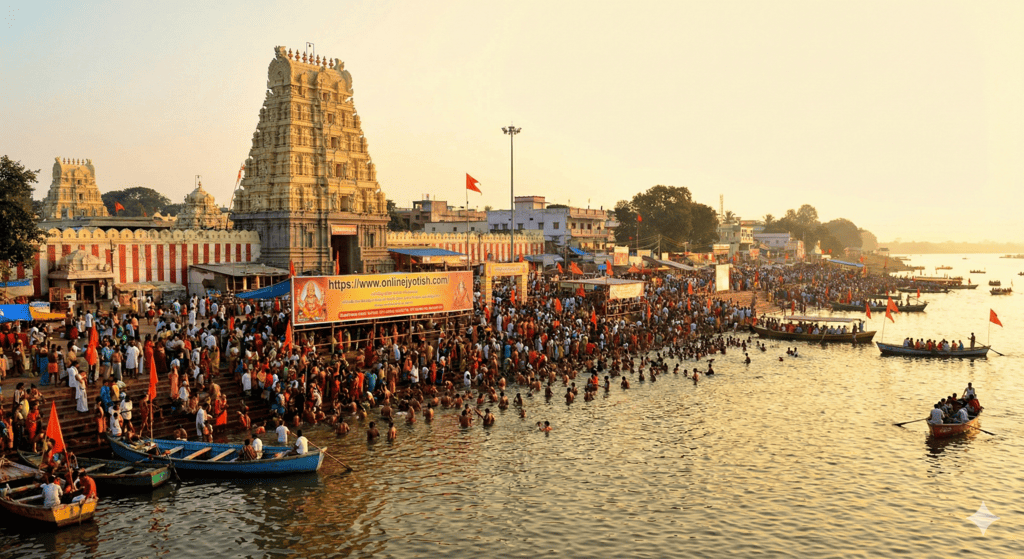
Whenever Godavari Pushkaralu approaches, one central question arises for most families: Can weddings be performed during that year? Are Upanayana (sacred thread ceremonies) and Grihapravesha (housewarmings) permitted? And how accurate is the common belief that people living south of the Godavari river face no dosha?
There is no blanket rule prohibiting all auspicious ceremonies across all regions for the entire Pushkara year. At the same time, those living south of the Godavari do not receive an unconditional exemption for the entire duration either. One must evaluate several factors together: the exact Nakshatra pada Jupiter is transiting in Leo, the Sun's sign placement, whether the ceremony is a marriage or another samskara, and the textual tradition followed in that region.
We have compiled this guide based on authoritative passages from Dharmasindhu, Nirnayasindhu, Muhurta Chintamani, and Muhurta Martanda. Planetary ingress timings for Jupiter and the Sun are calculated using OnlineJyotish sign and star transit tools. All timings listed below are in Indian Standard Time (IST, UTC+05:30).
Key Takeaways
- Pushkaralu and Simhastha Are Distinct: The end of the twelve-day Pushkara festival does not lift the Simhastha Guru dosha.
- Universal Prohibition Window: When Jupiter transits the four padas of Magha and the first pada of Purva Phalguni (Simha Navamsha), marriages and major auspicious ceremonies are prohibited across all regions (June 26, 2027 to September 15, 2027, 9:56 AM).
- Regional Exemption: Exemptions for regions south of the Godavari and north of the Ganga apply only after Jupiter enters the second pada of Purva Phalguni.
- Mesha Ravi Exception: While the Sun transits Aries (April 13, 2028, 9:44 PM to May 14, 2028, 6:37 PM), a special scriptural exception neutralizes Simhastha Guru dosha.
- Other Rituals Permitted: Daily worship, Pushkara holy dips, Seemantha, Jatakarma, and Annaprashana are not restricted by this rule.
The Twelve-Day Pushkaralu and the Simhastha Period Are Not the Same
The twelve-day Pushkara festival and the Simhastha period—when Jupiter transits Leo—are two distinct concepts. In matters of marriage and sacred ceremonies, classical texts primarily examine Simhastha Guru dosha. Therefore, assuming that weddings can resume for everyone from the thirteenth day simply because Pushkaralu lasts twelve days has no scriptural basis. Likewise, a period meritorious for sacred river bathing should not be assumed automatically auspicious for all mangalik ceremonies.
Dharmasindhu: Both Time and Region Must Be Evaluated
In the first chapter (Prathama Parichcheda) of Dharmasindhu, under the section “Atha Simhasthapavade Yatradinirnayashcha,” it states:
मघानक्षत्रगते सिंहांशगते च गुरौ सर्वदेशेषु सर्वमाङ्गलिककर्मणां निषेधः।
Meaning: When Jupiter is in Magha Nakshatra and in Simha Navamsha, all auspicious ceremonies are prohibited across all regions. In the very same passage, the regional exemption is stated as follows:
सिंहांशोत्तरं गोदादक्षिणे भागीरथ्युत्तरे सिंहस्थदोषो नास्ति।
Meaning: After Jupiter crosses Simha Navamsha, there is no Simhastha dosha in regions south of the Godavari and north of the Bhagirathi (Ganga). Omitting the crucial time qualifier “Simhamshottaram” and merely claiming that “there is no dosha south of the Godavari” is incomplete. Both the time limit and the geographical boundary must be observed together.
Muhurta Chintamani (Shubhashubha Prakarana, Verse 50) states this rule even more concisely:
मघादिपञ्चपादेषु गुरुः सर्वत्र निन्दितः।
गङ्गागोदान्तरं हित्वा शेषाङ्घ्रिषु न दोषकृत्॥
Meaning: When Jupiter occupies the five Nakshatra padas beginning with Magha, it is prohibited everywhere. In the remaining padas, Jupiter causes no dosha except in the region lying between the Ganga and the Godavari. These five padas are all four padas of Magha and the first pada of Purva Phalguni.
| Jupiter's Nakshatra Segment | Position in Leo | General Simhastha Rule |
|---|---|---|
| All four padas of Magha | 0° to 13°20′ | Prohibited in all regions |
| Purva Phalguni 1st pada (Simha Navamsha) | 13°20′ to 16°40′ | Prohibited in all regions |
| Purva Phalguni 2nd pada to the end of Leo | 16°40′ to 30° | Exemptions apply based on region and ceremony |
This table illustrates the general rule only; special remedies such as Mesha Ravi must be evaluated separately. Note also that this rule refers strictly to the Nakshatra pada transited by Jupiter—not the birth stars of the bride and groom, nor the Moon's Nakshatra on the wedding day.
Which Regions Receive Exemption and Where Does Prohibition Apply?
Regarding the belt between the Ganga and the Godavari, Dharmasindhu explicitly states:
गङ्गागोदामध्यदेशे तु सर्वसिंहस्थे विवाहव्रतबन्धयोर्दोषः।
This means that in the middle region—south of the Ganga and north of the Godavari—dosha applies to marriage and Vratabandha (Upanayana) for the entire duration Jupiter remains in Leo. Jupiter entering the second pada of Purva Phalguni does not grant marriage or Upanayana exemption to this central belt.
Nirnayasindhu also cites the dictum of Sage Vasishtha while discussing exceptions to Simhastha Guru:
भागीरथ्युत्तरे कूले गौतम्या दक्षिणे तथा।
विवाहो व्रतबन्धश्च सिंहस्थेज्ये न दुष्यति॥
This verse indicates that during Simhastha Guru, marriage and Upanayana are not blemished on the northern bank of the Bhagirathi and the southern bank of the Gautami (Godavari). However, this regional verse must be read in conjunction with the Nakshatra pada restrictions laid down in the companion texts.
| Region | Rule |
|---|---|
| Regions south of the Godavari | Exempt from Simhastha dosha after Jupiter crosses Magha and the first pada of Purva Phalguni. |
| Regions north of the Ganga | Exempt subject to the same Nakshatra pada time boundary above. |
| Central belt (south of Ganga, north of Godavari) | Generally prohibited throughout the entire Simhastha period; special exceptions like Mesha Ravi must be examined separately. |
| Kalinga, Gauda, and Gurjara lands | Subject to a specific prohibition in Muhurta Chintamani; standard regional exemptions cannot be applied directly. |
The basis for the last row is this line from Verse 51 of Muhurta Chintamani:
सर्वः सिंहगुरुर्वर्ज्यः कलिङ्गे गौडगुर्जरे।
This verse states that the entire Simhastha Guru period must be avoided in Kalinga, Gauda, and Gurjara. Because these are ancient geographical designations, equating them wholesale with modern state boundaries is inappropriate.
Similarly, within Telugu-speaking regions, broad state-level verdicts such as “exempt across all of Andhra Pradesh” or “prohibited across all of Telangana” cannot be issued. One must look at the specific locality's geographic position relative to the Godavari river. North Coastal Andhra (Uttarandhra) also has historical ties to Kalinga; the Visakhapatnam District Official History Page notes that the region formed part of the ancient Kalinga kingdom. While this historical context should be kept in mind, it alone cannot be used to impose a blanket prohibition on every modern village without local shastric discernment.
Mesha Ravi Exception for Simhastha Dosha
Dharmasindhu states this exception clearly:
मेषस्थे सूर्ये सर्वदेशेषु सर्वमाङ्गलिककर्माणि सर्वसिंहस्थे न दोषः।
This text declares that when the Sun is in Aries (Mesha), there is no Simhastha Guru dosha for any auspicious ceremony in any region, even throughout the Simhastha period. Verses 49–51 of Muhurta Chintamani also discuss the Mesha Ravi exception, extending it to marriage and Upanayana even in the Ganga–Godavari middle belt.
Do not confuse the solar Mesha month with the lunar Chaitra month. The Sun occupies Aries strictly from Mesha Sankranti until Vrishabha Sankranti. Always verify the exact solar ingress timings in that year's Panchangam.
Even when Simhastha dosha is neutralized, all other standard Muhurta requirements still apply. An auspicious marriage month, absence of Jupiter–Venus combustion (Moudhya), Tithi, Nakshatra, Lagna, Tara Bala, and Chandra Bala must all be verified independently. In traditions observing Kalinga-specific restrictions, how the Mesha Ravi exception is accepted should also be decided according to local commentaries and regional custom (Deshachara).
Mention of Urgent Circumstances in Muhurta Martanda
In the Martandavallabha commentary on Verse 53 of the Vivaha Prakarana in Muhurta Martanda, performing ceremonies south of the Godavari and north of the Ganga after Jupiter crosses Simha Navamsha is linked to urgent or pressing circumstances. Similarly, emergency situations are referenced when discussing the Mesha Ravi exception for the middle region (printed pages 146–147).
Therefore, one cannot claim that every classical treatise grants exemptions on identical terms or with equal latitude. While some traditions follow Dharmasindhu broadly, others adhere to the stricter conditions noted in the Martanda commentary.
Based on these passages, families belonging to a prohibited region cannot be guaranteed an automatic exemption simply by shifting the wedding venue south of the Godavari. The text quoted in the Martanda commentary also uses the expression “Godavaridakshinakulajataih” (those born on the southern bank of the Godavari). Family tradition, regional affiliation, and the venue of the ceremony must all be weighed together.
Grihapravesha, Pujas, and Other Samskaras
Applying the marriage prohibition to every auspicious ritual throughout the year is incorrect. Immediately after stating the rule for marriage and Upanayana, Dharmasindhu adds:
अन्यकर्माणि सिंहांशोत्तरं सर्वदेशेषु कर्तव्यानि।
This sentence clarifies that once Jupiter passes Simha Navamsha, other auspicious ceremonies may be performed in all regions. The Piyushadhara commentary on Muhurta Chintamani likewise singles out only marriage and Vratabandha in the context of the central belt.
Consequently, for ceremonies like Grihapravesha and deity consecration (Pratishtha), one should examine both the Simhastha rule and the specific Muhurta rules governing those rituals. Assuming that every puja is forbidden just because weddings are restricted is mistaken.
Nor does it mean halting daily worship, Sandhyavandanam, or time-bound samskaras. In Jyotirmayukha (Vivahadi Samskara Prakarana, Simhastha Guru Vichara), it is stated:
सीमन्तजातकादीनि प्राशनान्तानि च क्रमात्।
कर्तव्यानि न दोषोऽस्ति पञ्चाननगते गुरौ॥
This verse confirms that sequential samskaras from Seemantha and Jatakarma up to Annaprashana may be performed without dosha even while Jupiter is in Leo (Panchanana), following their prescribed timings. In the same context, Dharmasindhu extols pilgrimage and sacred bathing in the Godavari. Time restrictions on weddings do not prohibit Pushkara Snana.
When Do These Rules Apply in 2027–2028?
According to the East Godavari District Administration announcement, the 2027 Godavari Pushkaralu festival will take place from June 26 to July 7, 2027 (Official District Government Notification).
According to OnlineJyotish's Planet Sign Transit Tool and Planet Star Transit Tool, Jupiter enters Leo and Magha Nakshatra on June 26, 2027, at 5:19 AM, and enters Purva Phalguni Nakshatra on August 31, 2027, at 12:33 AM. Thus, throughout the twelve-day festival, Jupiter remains in Magha Nakshatra.
Under the general rules of Dharmasindhu and Muhurta Chintamani cited above, the southern Godavari exemption does not apply to marriages during those twelve days. Nor does the prohibition end immediately when Jupiter enters Purva Phalguni on August 31; Jupiter must complete the first pada of Purva Phalguni.
| Period | Explanation Under Scriptural Rules |
|---|---|
| June 26, 2027 (5:19 AM) to September 15, 2027 (9:56 AM) | Jupiter transits all four padas of Magha and the first pada of Purva Phalguni. Generally prohibited across all regions. |
| September 15, 2027 (9:56 AM) to November 26, 2027 (6:45 PM) | Jupiter crosses Simha Navamsha. Regional exemptions south of the Godavari and north of the Ganga may be considered. |
| February 28, 2028 (7:17 PM) to July 24, 2028 (3:37 PM) | Jupiter re-enters Leo. During this leg, it does not retrograde into the first five padas; regional exemptions apply for evaluation. |
| April 13, 2028 (9:44 PM) to May 14, 2028 (6:37 PM) | The Sun transits Aries. Period eligible for the Mesha Ravi exception mentioned in Dharmasindhu. |
Calculation Basis: Sign and star ingress timings were obtained from OnlineJyotish tools using Rajamahendravaram and the Asia/Kolkata timezone. The start of Purva Phalguni's second pada is not displayed separately in the star transit tool; it was computed specifically for the 16°40′ Leo boundary using the same website's Lahiri Ayanamsa planetary engine. Entering Purva Phalguni Nakshatra and entering its second pada are two distinct events.
These dates are not printed in ancient texts; they represent the application of classical rules to modern astronomical calculations. Timings are rounded to the nearest minute. The intervals shown in this table do not imply that every day within them has valid wedding Muhurtas. For instance, although regional exemption begins on September 15, a wedding cannot automatically be fixed on that exact date—the lunar month, combustion rules, retrograde/accelerating motion rules, personal planetary strengths, and local Lagna purity must all align favorably.
Jupiter's Three Transit Phases in Leo
Because of Jupiter's retrograde motion, its transit through Leo occurs with breaks rather than one uninterrupted stretch. According to the OnlineJyotish Sign Transit Tool, Jupiter's Leo transit unfolds in three phases:
| Phase | Ingress into Leo | Egress from Leo |
|---|---|---|
| 1 | October 31, 2026, 12:03 PM | January 25, 2027, 1:32 AM (into Cancer) |
| 2 | June 26, 2027, 5:19 AM | November 26, 2027, 6:45 PM (into Virgo) |
| 3 | February 28, 2028, 7:17 PM | July 24, 2028, 3:37 PM (into Virgo) |
Therefore, treating twelve consecutive months from the festival start date as a single unbroken prohibition window is inaccurate. During the intermediate intervals when Jupiter is outside Leo, Simhastha dosha does not apply, though all other standard Muhurta rules still govern.
When finalizing a Muhurta for any family, one must first identify the textual tradition they follow, and then examine Jupiter's sign and Nakshatra pada, the applicable regional rule, the nature of the ceremony, valid exceptions, and overall Panchangam purity. Only then can an accurate, auspicious Muhurta be determined for that family, location, and event.
Frequently Asked Questions (FAQ)
1. Can marriages be performed immediately after the 12 days of Godavari Pushkaralu end?
No. Although the Pushkaralu festival lasts 12 days (June 26 to July 7, 2027), Simhastha Guru dosha lasts longer. Until Jupiter crosses all four padas of Magha and the first pada of Purva Phalguni (September 15, 2027, at 9:56 AM), marriages and major auspicious ceremonies are generally prohibited across all regions.
2. When does Simhastha dosha cease for people living south of the Godavari?
Exemption for regions south of the Godavari and north of the Ganga begins only after September 15, 2027, at 9:56 AM, once Jupiter enters the second pada of Purva Phalguni. In the central region between the Ganga and the Godavari, prohibition continues throughout the Simhastha period (except during special windows like Mesha Ravi).
3. Are Grihapravesha, Seemantha, and Annaprashana allowed during Godavari Pushkaralu?
Samskaras such as Seemantha, Jatakarma, and Annaprashana may be performed at their prescribed times without dosha. Ceremonies like Grihapravesha and deity consecration may be conducted after Jupiter crosses Simha Navamsha (Purva Phalguni 1st pada), subject to the specific Muhurta rules for those rituals.
Consulted Texts and References
- Dharmasindhu (by Kashinatha Upadhyaya): Khemraj Shrikrishnadas edition with Mihirachandra Hindi commentary. Prathama Parichcheda, “Atha Simhastha Varjyani” and “Atha Simhasthapavade Yatradinirnayashcha”; printed page 10 (page 28 in the consulted digital copy).
- Muhurta Chintamani (by Ramadaivajna, with Piyushadhara commentary): Shubhashubha Prakarana, Verses 49–51; printed pages 59–60 (pages 111–112 in the consulted digital copy).
- Muhurta Martanda (with Martandavallabha commentary): Edited by Dr. Satyendra Mishra; Vivaha Prakarana, commentary on Verse 53; printed pages 146–147 (pages 159–160 in the digital copy).
- Nirnayasindhu (by Kamalakara Bhatta): Tritiya Parichcheda, Gurubala and Simhastha Guru exception context for marriage. Original Sanskrit Text.
- Jyotirmayukha: Vivahadi Samskara Prakarana, Simhastha Guru Vichara, specifically Verses 13–19. Sanskrit Text and Marathi Explanation.
- OnlineJyotish Planetary Calculations: Planet Sign Transit Tool, Planet Star Transit Tool. Rajamahendravaram, IST; relevant 2026–2028 yearly and monthly tables, with dedicated boundary calculation for Purva Phalguni 2nd pada using the same Lahiri engine.
- Pushkara Festival Dates: Official Announcement by East Godavari District Administration.
- Kalinga Historical Context: Visakhapatnam District Government History Page.
References and transit calculations verified: . Page numbers may vary across printed editions; therefore, chapter and verse numbers are also cited.