
Use the hospital or official time
Enter the recorded local clock time, not a manually converted timezone value.

Enter the baby’s recorded local birth time and birthplace to calculate Rashi, Nakshatra, Pada, naming syllables and the chart details included in the report.
The report is a cultural astrology reference. It does not assess the baby’s health, development, intelligence or future.
Enter the recorded local clock time, not a manually converted timezone value.
Check the city, country, coordinates and timezone, especially when places share a name.
Nakshatra syllables are a family and cultural convention, not a compulsory naming rule.
Check the recorded date, local time, birthplace and timezone before generating the report.
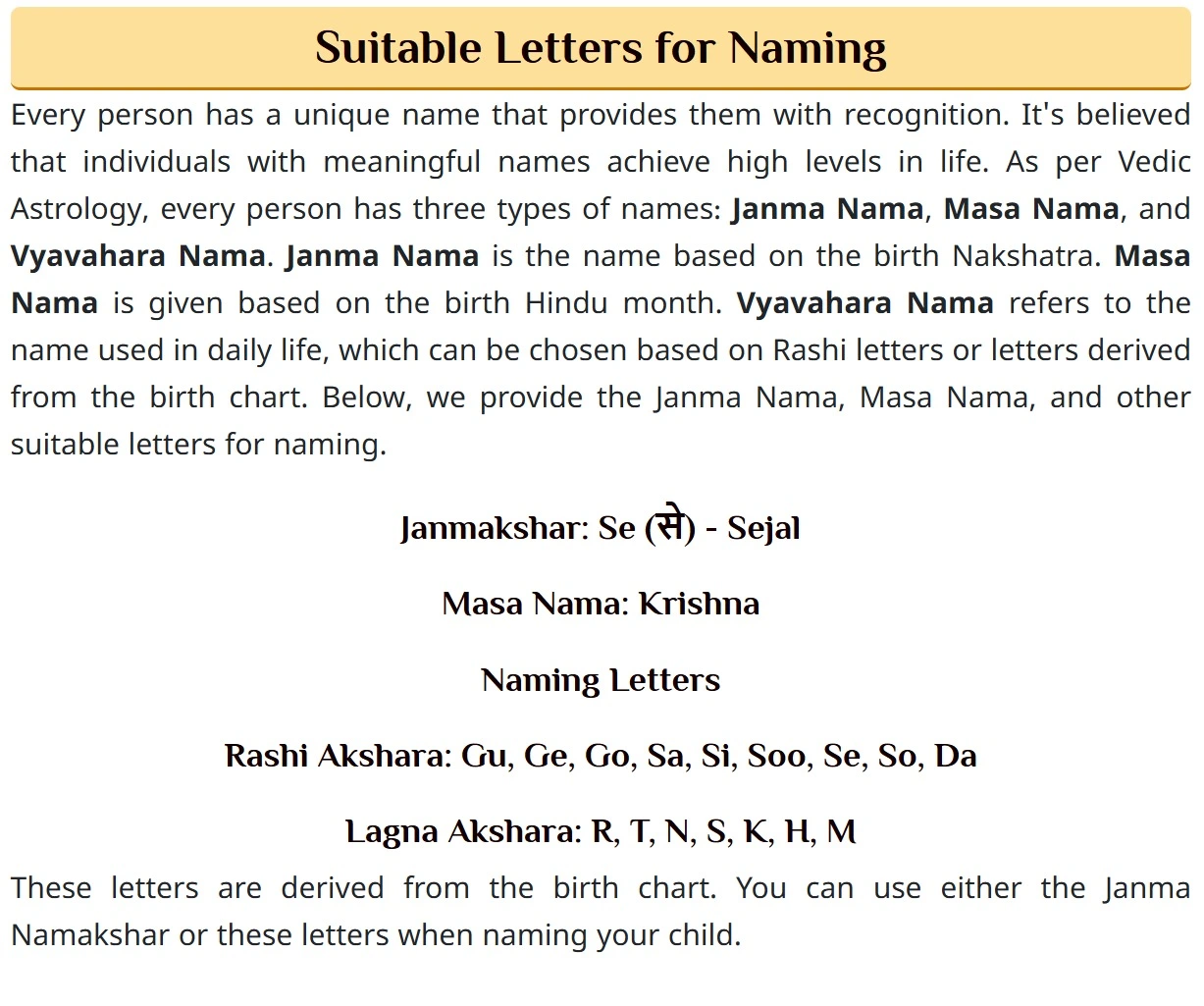
The exact tables and text can vary with the current report version and submitted birth details.
The sidereal Moon sign calculated for the recorded birth time and place.
The 13°20′ lunar mansion occupied by the Moon at birth.
One of four 3°20′ quarters within the birth Nakshatra.
Traditional starting sounds associated with the Nakshatra Pada for families who follow Namakarana conventions.
The available lunar-day and calendar values calculated for the birth moment and location.
A compact traditional table that can include Rashi, Nakshatra, Gana, Nadi, Yoni, Varna and related classifications.
The Ascendant-based and Moon-sign chart presentations supplied by the newborn report.
A symbolic traditional classification calculated under the method used by the report. It is not a health or fortune diagnosis.
Shows whether the Nakshatra is included in the Gandamoola group under the report’s tradition. It does not predict harm to the child or family.
This is a traditional Nakshatra grouping. Regional rules and Shanti customs vary, and the label does not prove harm to the baby or family.
Gold, silver, copper or iron Paya is a symbolic classification in some traditions. It is not a measure of health, worth or destiny.
It is a birth chart calculated from the baby’s date, local time and birthplace. This report focuses on Rashi, Nakshatra, Pada, naming syllables and available traditional chart details.
The Lagna changes continuously and the Moon can cross a Pada, Nakshatra or Rashi boundary. A small time difference matters most when a calculated point is near a boundary.
Use the time recorded by the hospital or birth record according to local civil time. Do not manually convert it to another timezone.
Each Nakshatra Pada is associated with traditional starting sounds. Families may use one of those sounds for Namakarana, but it is a cultural option rather than a compulsory rule.
No. A naming syllable is a traditional convention. It does not determine intelligence, health, personality, education or success.
Gandamoola is a traditional grouping of selected Nakshatras or their portions. Interpretations and Shanti practices vary. The label should not be used to frighten or stigmatise a child or parent.
No certain harm to the baby, mother, father or relatives can be concluded from the label. Medical and developmental concerns require qualified pediatric care.
Paya is a symbolic classification described as gold, silver, copper or iron in some traditions. It should not be treated as a measure of health, wealth, worth or destiny.
No. It is not a pediatric, genetic or developmental assessment. Vaccination, feeding, growth, hearing, vision, speech and developmental concerns should be discussed with qualified health professionals.
No. Names, dates, times and places shown in the report should be checked against official records. The horoscope is not a legal document.
Differences can arise from Ayanamsha, timezone or daylight-saving data, coordinates, ephemeris settings, house system and rounding near a boundary.

This newborn horoscope page is maintained under the guidance of Santhosh Kumar Sharma Gollapelli for traditional astrology and naming reference.
Read the background and methodology →
For those who want a complete birth horoscope, OnlineJyotish.com offers Exclusive and Premium Janmakundali reports. This comprehensive horoscope contains more than 400 pages, including detailed analysis of every house; special insights into education, health, marriage, children, career, fortune and life purpose; complete details of yogas, doshas and remedies; Shadvarga results; planetary Avastha interpretations; Ashtakavarga analysis and predictions; Vimshopaka Bala and its results; Dasha, Antardasha and Pratyantardasha predictions covering 100 years; transit dates of Jupiter, Saturn, Rahu and Ketu for 100 years; and detailed transit predictions of Jupiter, Saturn, Rahu and Ketu for the next 10 years, along with many more special features. It is a comprehensive 400+ page Brihat Janmakundali. Click below to receive your complete horoscope within moments.