
Confirm Nakshatra and Paksha
The birth-bird rule commonly depends on the birth Nakshatra and waxing or waning lunar phase.

Enter your birth details to calculate the birth bird used by this forecast and view its symbolic activity periods for the selected day and location.
The periods are traditional planning references, not guarantees of success, failure, safety or danger.
The birth-bird rule commonly depends on the birth Nakshatra and waxing or waning lunar phase.
Sunrise, sunset and the length of day and night affect the displayed clock periods.
Important actions still require practical preparation, safety and any relevant professional advice.
Enter the recorded local birth time and birthplace first. Then enter the city where you want to use the forecast. Check both locations and time zones; they serve different purposes.
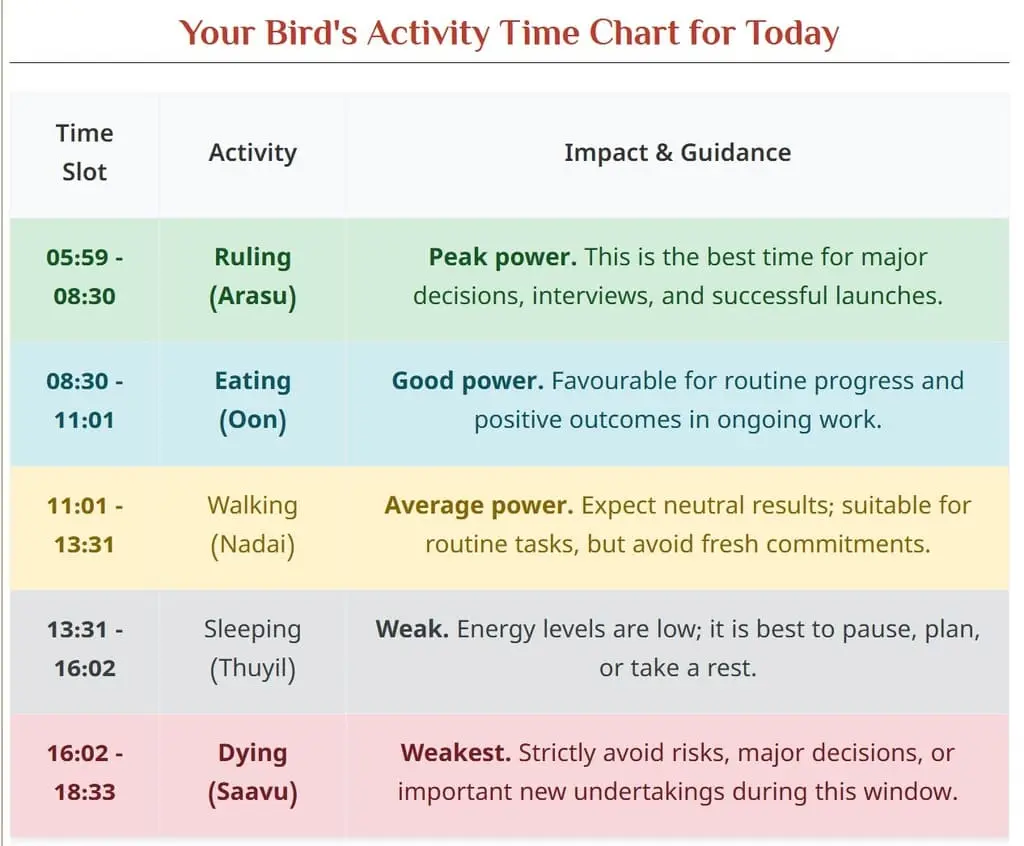
The exact periods depend on the submitted birth data, date, location and rule tables used by the engine.
Valluru
Aandhai
Kaakam
Kozhi
Mayil
Traditionally treated as the strongest activity within the cycle. It is not a guarantee that an action will succeed.
Traditionally treated as a supportive activity period for steady or constructive work.
A middle-strength period commonly used for ordinary movement and routine activity.
A lower-activity period often associated with rest, review or less demanding work.
The name of the weakest symbolic activity in the cycle. It does not predict death, injury or another harmful event.
Lineages or programs may use different Nakshatra and Paksha assignment tables.
Local sunrise and sunset determine the daytime and nighttime intervals.
The activity order and ruling bird can depend on the weekday and Paksha convention.
Some methods add finer sub-periods or relationship factors not shown by every calculator.
Pancha Pakshi is a Tamil traditional timing system that assigns one of five symbolic birds and cycles each bird through five activities during day and night.
The method commonly uses the birth Nakshatra and the waxing or waning lunar phase. The exact rule table can vary by lineage or software implementation.
The activity sequence and subdivisions are traditionally applied separately to the local daytime and nighttime. Sunrise and sunset therefore affect the displayed clock periods.
No. Ruling is the strongest symbolic activity in the traditional cycle, but real outcomes depend on preparation, circumstances, skill, consent, safety and many other factors.
No. Saavu is a traditional activity label within the five-part cycle. It should not be interpreted as a prediction of death, illness, accident or disaster.
Local sunrise, sunset and day-night lengths affect the clock-time divisions. An incorrect city, timezone or daylight-saving setting can shift the periods.
It should not be used as a guarantee for trading, gambling or investment outcomes. Financial decisions require risk analysis and qualified advice.
No. A full Muhurta may also consider the activity, Tithi, Nakshatra, Yoga, Karana, Lagna, planetary conditions and personal birth factors.
Differences can arise from the birth-bird table, Paksha convention, weekday sequence, sunrise and sunset definitions, location data and subdivision rules.

This Pancha Pakshi page is maintained under the guidance of Santhosh Kumar Sharma Gollapelli as a traditional timing reference.
Read the background and methodology →
For those who want a complete birth horoscope, OnlineJyotish.com offers Exclusive and Premium Janmakundali reports. This comprehensive horoscope contains more than 400 pages, including detailed analysis of every house; special insights into education, health, marriage, children, career, fortune and life purpose; complete details of yogas, doshas and remedies; Shadvarga results; planetary Avastha interpretations; Ashtakavarga analysis and predictions; Vimshopaka Bala and its results; Dasha, Antardasha and Pratyantardasha predictions covering 100 years; transit dates of Jupiter, Saturn, Rahu and Ketu for 100 years; and detailed transit predictions of Jupiter, Saturn, Rahu and Ketu for the next 10 years, along with many more special features. It is a comprehensive 400+ page Brihat Janmakundali. Click below to receive your complete horoscope within moments.