
Use the best available birth record
A few minutes can affect the Lagna degree, houses, Navamsha and other time-sensitive chart factors.

This service creates a Vedic horoscope with the calculated Lagna, planetary positions, Rashi and Navamsha charts, Vimshottari Dasha and the analysis sections available in the current report version.
A calculated chart is not a fixed verdict about a person’s character or future. Interpretation depends on the chosen method, birth-time accuracy and the full chart context.
A few minutes can affect the Lagna degree, houses, Navamsha and other time-sensitive chart factors.
City and country determine coordinates, timezone and historical daylight-saving rules.
When comparing reports, check Ayanamsha, node type, house method and Geocentric or Topocentric option.
Engine file updated: · Swiss Ephemeris · Lahiri Ayanamsha
Enter the local birth time as recorded. Do not manually convert it to UTC.
The exact sections can vary with the selected options and current report version.
The main sidereal birth chart showing the Lagna, planetary signs and the house framework used by the report.
A divisional chart commonly used as a supporting chart for planetary dignity, marriage-related interpretation and deeper chart assessment.
Shows planets by calculated house position. A planet can remain in the same sign while moving to another Bhava in the Chalit presentation.
Lists planetary longitudes, signs, Nakshatras, Padas, motion and other values produced by the calculation engine.
Shows the traditional planetary-period sequence calculated from the Moon’s Nakshatra and the balance remaining at birth.
Presents the available sixfold planetary-strength calculations. A numerical strength result does not by itself determine whether a planet gives only good or bad outcomes.
Provides the available point-based transit and house-strength framework used in several Vedic astrology traditions.
The report may check Mangal Dosha, Sade Sati, Kala Sarpa arrangements and other traditional conditions implemented by the engine.
Where available, the report presents traditional explanations for planets, houses, Dashas and combinations in accessible language.
Confirm the displayed date, time, place, coordinates and timezone before interpreting the chart.
Review the rising sign, Lagna degree and the condition of the Lagna lord in the full chart.
A planet’s sign, house, ownership, aspects, conjunctions and strength should be considered together.
Navamsha and other divisional charts support the main chart; they should not be read in isolation.
Dashas organize traditional planetary periods, but actual outcomes still depend on the full chart and real circumstances.
A Dosha is one chart condition with possible exceptions and balancing factors—not a final judgment.
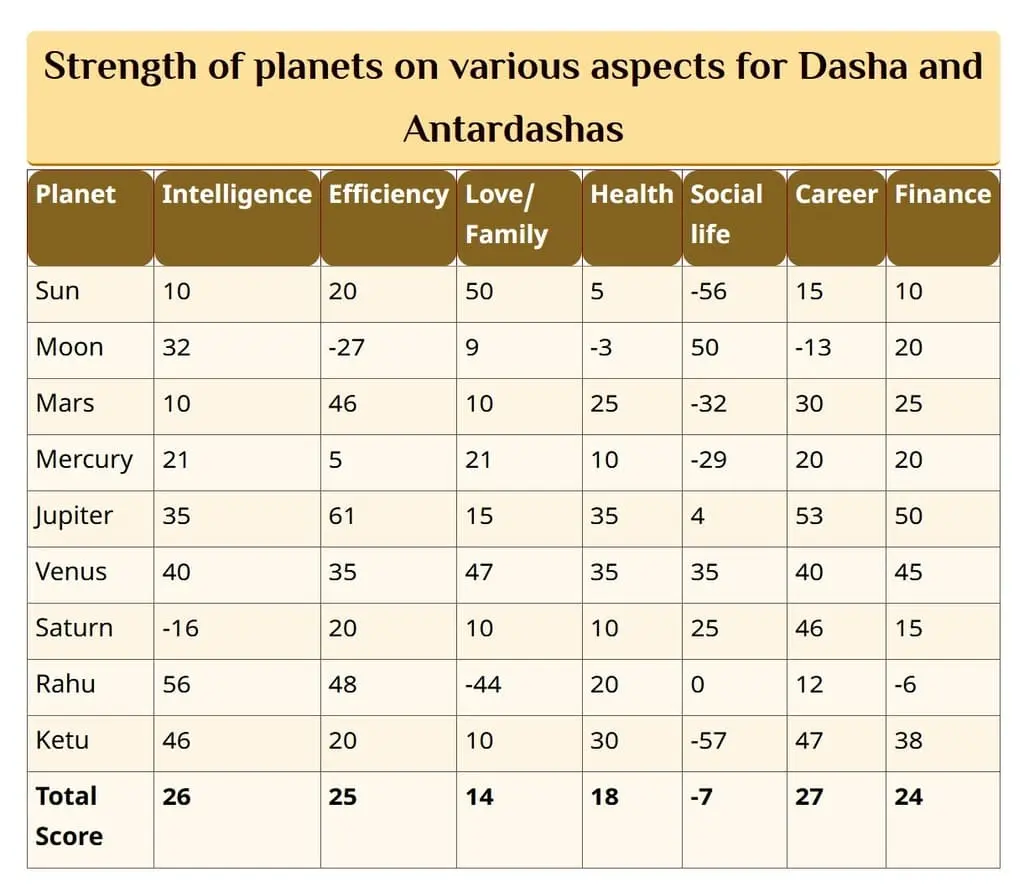
The generated report may include these chart and table sections. The exact content depends on the current report version and selected options.
The Lagna and houses are time-sensitive. A small time difference can change the Ascendant degree, house cusps, Navamsha and other divisional-chart placements, especially near a boundary.
You may generate a chart with an estimated time, but the Lagna, houses and time-sensitive Vargas may be unreliable. The Moon sign and planetary positions can also change when the estimate crosses a planetary or Nakshatra boundary.
A daily horoscope gives broad sign-based themes to many readers. A Janam Kundli is calculated from one person’s date, time and place and can show Lagna, houses, planetary positions, Vargas and Dashas.
Geocentric calculation uses the centre of the Earth as the reference point. Topocentric calculation uses the observer’s location on the Earth’s surface. The difference is usually small but can affect sensitive values in some calculations.
Differences can arise from Ayanamsha, mean or true nodes, house system, geocentric or topocentric setting, coordinates, timezone, daylight saving, ephemeris version and rounding.
No. Shadbala measures forms of planetary strength within a traditional framework. Interpretation also depends on house ownership, placement, aspects, conjunctions, dignity, Dashas and the rest of the chart.
No. A Dosha is one traditional chart condition. Its scope, exceptions and weight vary by method, and it should not be converted into a certain prediction of illness, death, marriage failure or financial loss.
No. Mantras, worship, charity and similar remedies are religious or cultural options. They do not guarantee an outcome and do not replace medical, legal, financial or psychological assistance.
The page presents the core chart and available analysis without requiring a payment before calculation. The exact sections shown can depend on the current report version and selected options.
Birth details are personal information. Review the current privacy policy before submitting data, enter another person’s details only with permission and avoid assuming that a public web form provides confidential professional consultation.
No. Use it for traditional astrology study and personal reflection. Medical, legal, financial, employment, safety and mental-health decisions require appropriately qualified professionals.

This horoscope engine and its explanatory content are maintained under the guidance of Santhosh Kumar Sharma Gollapelli for traditional Vedic astrology study.
OnlineJyotish was created to make chart calculations easier to access after the practical difficulty of preparing complete horoscopes manually. The service has been developed through 26 years of practice.
Read the background and methodology →
For those who want a complete birth horoscope, OnlineJyotish.com offers Exclusive and Premium Janmakundali reports. This comprehensive horoscope contains more than 400 pages, including detailed analysis of every house; special insights into education, health, marriage, children, career, fortune and life purpose; complete details of yogas, doshas and remedies; Shadvarga results; planetary Avastha interpretations; Ashtakavarga analysis and predictions; Vimshopaka Bala and its results; Dasha, Antardasha and Pratyantardasha predictions covering 100 years; transit dates of Jupiter, Saturn, Rahu and Ketu for 100 years; and detailed transit predictions of Jupiter, Saturn, Rahu and Ketu for the next 10 years, along with many more special features. It is a comprehensive 400+ page Brihat Janmakundali. Click below to receive your complete horoscope within moments.